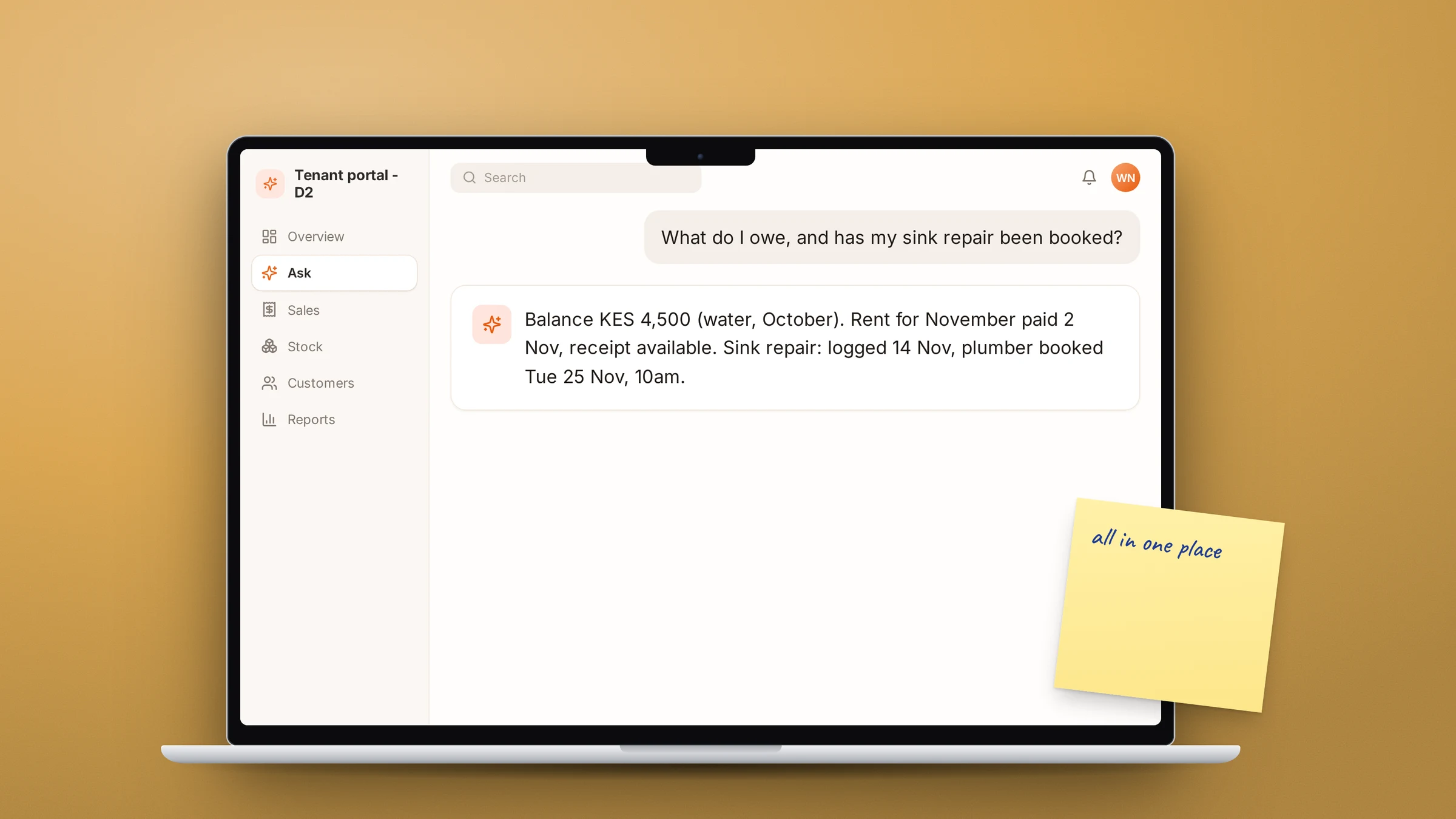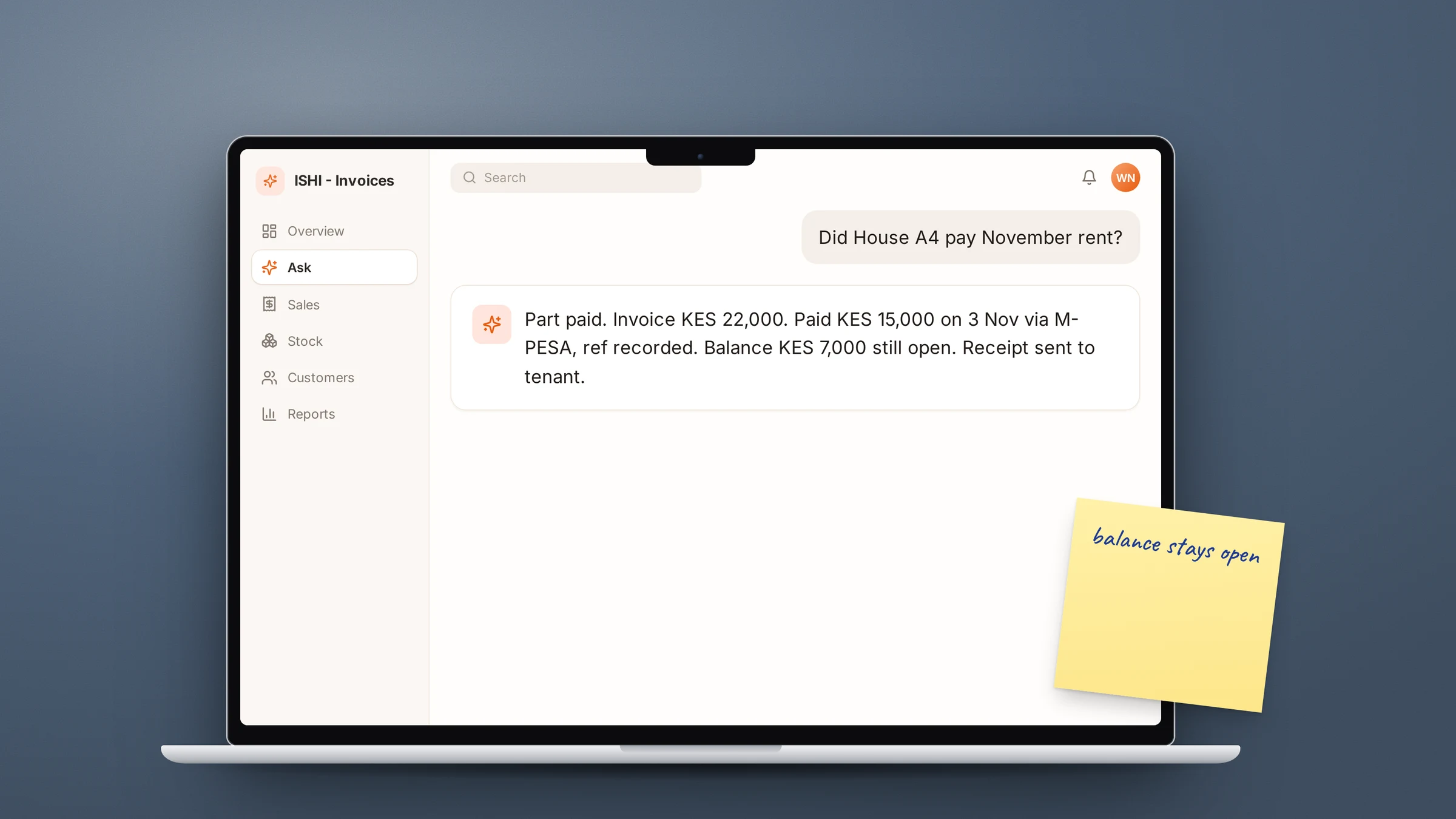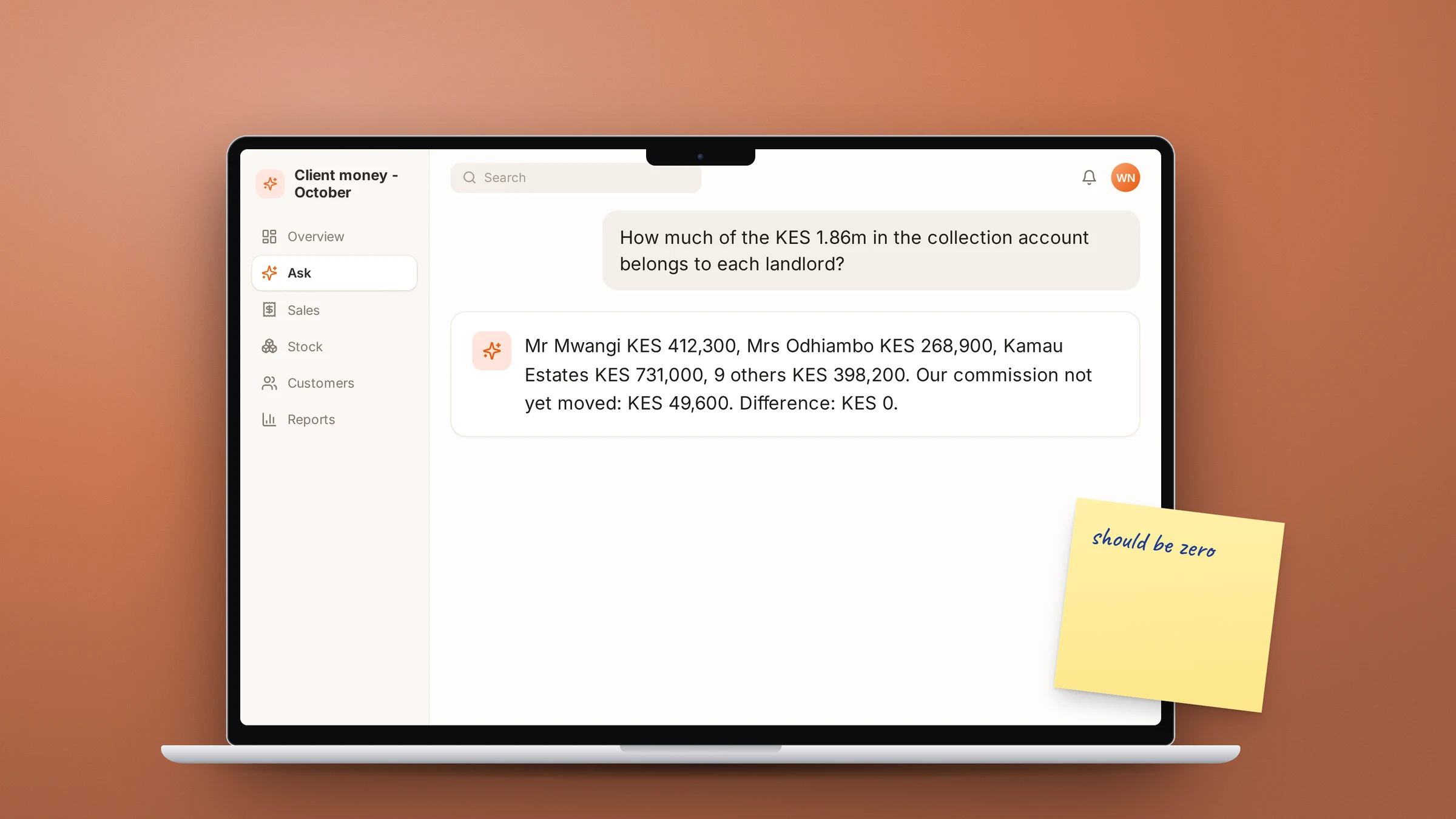
Take an illustrative agency in Ruaka that manages about ninety units for twelve different landlords. All the rent goes into one bank account and one paybill. For a long time that worked well enough: at month end, the office manager would add up each landlord's rent, subtract their repairs and commission, and send them the rest.
Then a landlord called. He had sold his block, and he wanted every shilling the agency was holding for him, today, with a list. The office manager spent two days building that list from M-PESA messages, receipt books and memory. She got close. She did not get exact. And "close" is a hard word to say to someone asking about their own money.
If you collect for more than one owner, the money in your account is not yours. Most of it belongs to other people, in different amounts, and at any moment you should be able to say exactly how much belongs to each.
The idea: one ledger per landlord#
Think of each landlord as having their own small bank account inside yours. You do not need separate bank accounts to start (though many agencies choose to), but you do need a separate record for each owner.
Every landlord's ledger has the same simple columns:
| Date | What | In | Out | Held |
|---|---|---|---|---|
| 3 Oct | Rent, Unit B2, J. Njeri | 15,000 | 15,000 | |
| 5 Oct | Rent, Unit B4, P. Ochieng | 15,000 | 30,000 | |
| 9 Oct | Plumber, Unit B2 | 2,500 | 27,500 | |
| 31 Oct | Commission 10% | 3,000 | 24,500 | |
| 31 Oct | Paid to landlord | 24,500 | 0 |
The "held" column is the number the landlord in Ruaka was asking for. If every ledger is kept up, the answer takes a minute, not two days.
Tag every shilling the day it arrives#
The single habit that makes this work: every payment is assigned to a landlord the day it lands. Not at month end.
When rent comes in by M-PESA or bank transfer, the receiving person writes one line: date, amount, transaction code, tenant, unit, and so which landlord. If a tenant pays without a clear reference, the line goes into an "unassigned" list, and somebody calls the tenant that day.
Two more rules prevent most of the errors:
- Tenant deposits are tracked on their own. A deposit is money you will one day hand back to a tenant, or apply against damage on the landlord's instruction. It is not rent and should not flow out with the monthly payment. We go through the full routine in deposits: record them and refund them without disputes.
- Expenses carry a receipt and a unit. "Plumber, KES 2,500" is not enough. "Plumber, Unit B2, receipt 0412" is. Landlords question expenses far more than rent.
The monthly check that keeps you honest#
Once a month, before any money goes out to landlords, do one sum:
Bank and paybill balance = sum of all landlords' held amounts + deposits held + your own fees not yet moved out.
If both sides match, the records are right. If they do not, stop and find the difference before paying anybody. The usual causes are a payment assigned to the wrong landlord, an expense paid but never recorded, or commission taken twice.
It is also wise to move your commission out of the collection account as soon as it is earned. Your money mixed with theirs is how agencies end up spending a landlord's rent without meaning to.
Statements landlords can trust#
At month end, each landlord gets a statement printed straight from their ledger: opening balance, every rent received with unit and tenant, every expense with its receipt, commission, the amount paid out, and the closing balance held. Nothing more. For what owners usually want on that page, see landlord statements: what owners want to see each month.
When the records live on paper or in a spreadsheet, this is stage 0 work, and it should be. A good spreadsheet with one tab per landlord is enough for a small agency. As you grow, a system such as ISHI, which keeps units, leases and rent together, saves the retyping. But the rules above stay the same in any tool.
What to do this week#
Pick one landlord, ideally your most demanding. Build their ledger for the last three months from your records. Work out what you should be holding for them today. If it takes more than an hour, or the answer surprises you, you have found the reason to set up ledgers for everyone else before month end.