Picture a car yard owner off Mombasa Road who wants a chatbot on his website. Buyers would ask about any car on the lot, and it would answer day and night: price, mileage, finance, viewing times. It is a reasonable wish. It is also the place where an AI mistake is most expensive, because the first person to see the mistake is a customer.
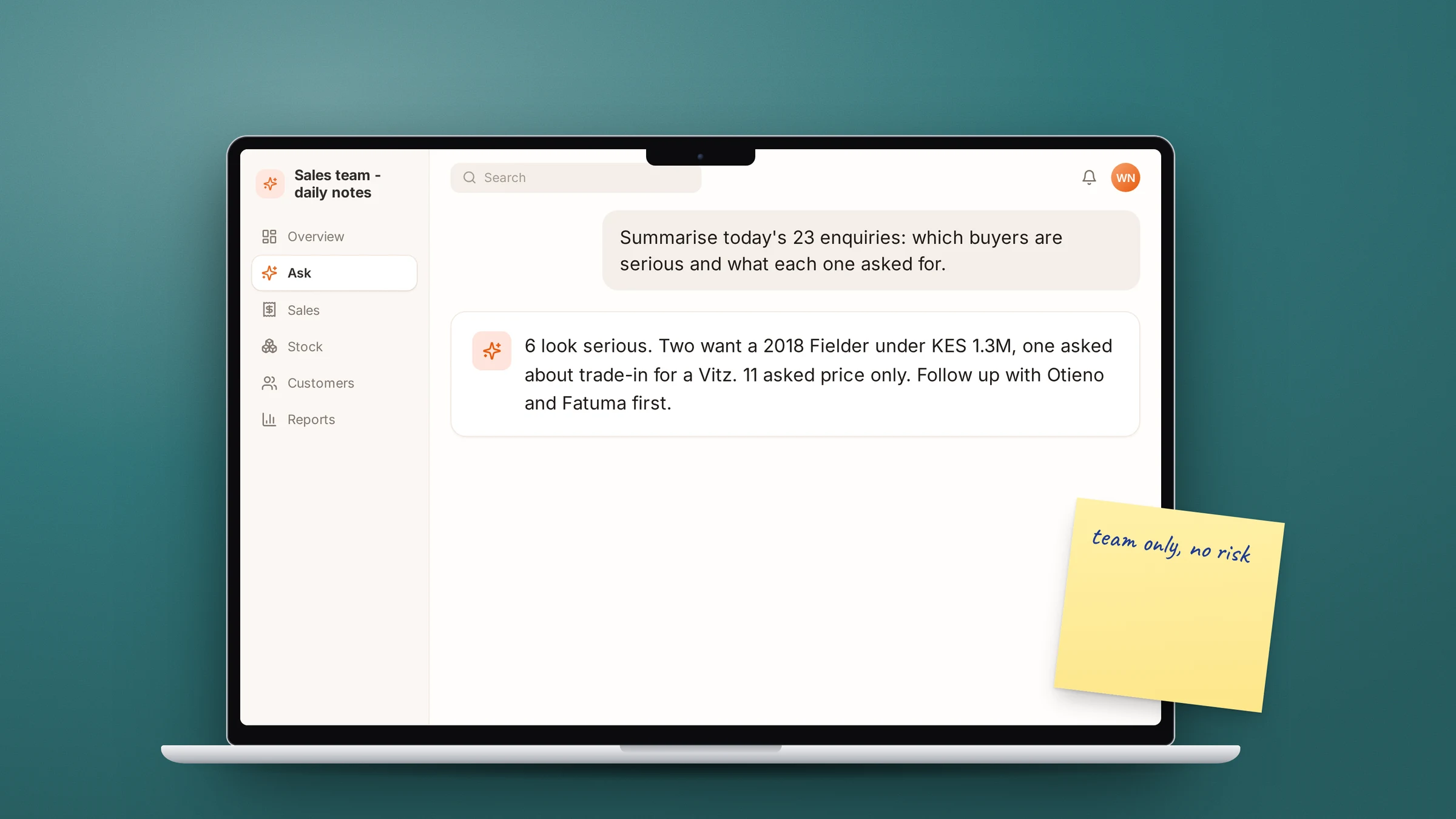
What I would suggest instead is smaller and less exciting: start with the sales team, not the buyers. Use AI to summarise the day's enquiries, draft listing descriptions for the team to edit, and turn the sales manager's voice notes into a follow-up list. If any of that goes wrong, a salesperson notices and fixes it before a buyer ever sees it.
That is the whole argument of this piece, and it applies to almost any business at Stage 1 of the NGAZI ladder.
A mistake inside costs a correction; outside, it costs a customer#
When an internal draft is wrong, someone on your team reads it, frowns, and fixes it. The cost is a minute. When a customer-facing answer is wrong, the cost is different in kind:
- The customer acts on it. They drive to the yard for a car that was sold yesterday, or expect a price you never offered.
- The mistake is in writing, in their phone, with your name on it.
- You may never hear about it. They just do not come back.
AI models can produce fluent, confident text that is simply wrong. That does not make them useless; it means someone has to read the output before it counts. Internally, that someone is already there. In front of customers, you have to build them in, and that is a harder project. We wrote about where the line sits in when AI should not touch your customer messages.
You learn faster where you can see every answer#
The first few weeks with any AI tool are mostly learning: what it is good at, where it goes wrong, how to phrase a request, what to check. Internally, you see every output. You notice that it confuses two similar models of car, or rounds prices oddly, or writes in a tone your customers would find stiff. Each of those becomes a fix to how you ask.
Put the same tool in front of customers first and you see only the conversations someone happens to read. The lessons arrive late, and usually as complaints.
Staff need to trust it before customers do#
The people who will run any AI tool day to day are your staff. If their first meeting with it is a chatbot answering customers on their behalf, the natural reading is "this is here to replace me", and the natural response is to hope it fails.
When their first meeting is a tool that saves them the dullest part of their day, writing up enquiries, drafting the same description for the fortieth Toyota, the reading changes. They become the people who know where it is good and where it is not. Those are exactly the people you want supervising it when it does eventually speak to customers.
Good internal first projects#
Pick something your team does every day that involves reading or writing, where a person already checks the result. Some that work in most businesses:
- Summarising the day's enquiries from WhatsApp or email into a short list for the team.
- Drafting product or listing descriptions that staff edit before publishing.
- Turning meeting or voice notes into action lists with names and dates.
- Drafting supplier messages and follow-ups, read and sent by a person.
- Answering staff questions from your own policy document, like leave rules or returns policy, with the source quoted.
Five boring tasks to hand AI before anything exciting has more, with how to start each one.
When to go customer-facing#
Move outward when three things are true: the internal version has run for some weeks and the team trusts it, you know its usual mistakes and have checks for them, and you have a clear rule for when it hands over to a person. At that point, a customer tool is a step you understand, not a gamble.
What to do this week#
List three jobs your team does every day that involve reading or writing. For each, write who checks the result today. Pick the one where a mistake would be cheapest and the checker is already in place. Try AI on that job for one week, with the checker reading every output, and write down every mistake it makes. That list is the most useful thing you will have when you plan your first customer-facing project.