Take Njeri, who runs a bakery in Thika that takes custom cake orders on WhatsApp, and wonders whether she should "get AI" for her orders. List what she wants and it comes to five things: remind customers the day before collection, tell the kitchen what to bake each morning, record deposits paid on M-PESA, send a thank-you after collection, and read the order messages that arrive as long voice notes and paragraphs.
Four of those five need no AI at all. They are automation: the same steps, with the same inputs, every time. Only the last one, reading what people actually write, is a job for AI. Knowing the difference saves her money and gets her a working system sooner.
The one-question test#
Ask: if I wrote the steps down, would they be the same every time?
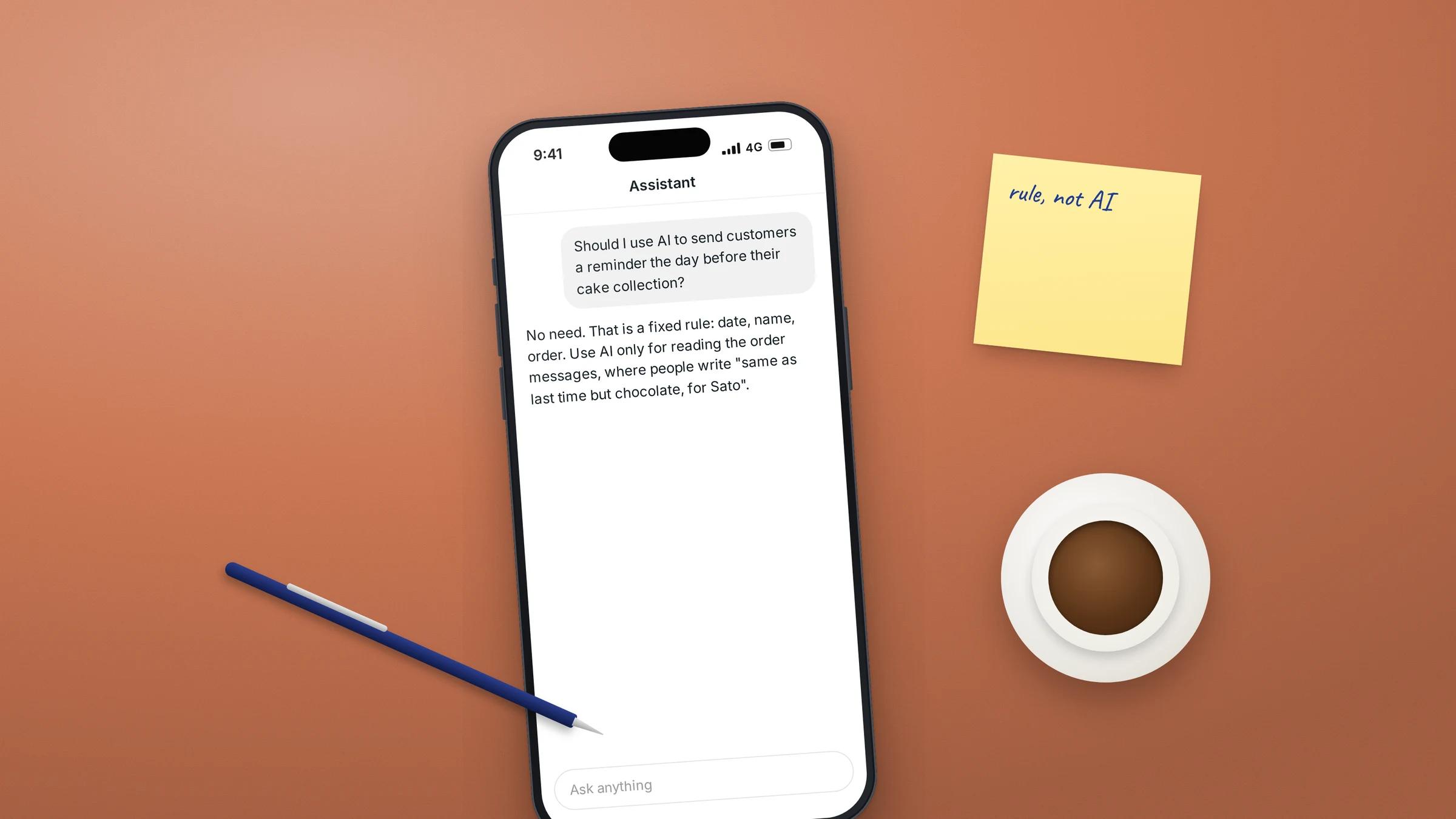
If yes, it is automation. A reminder the day before collection is "find every order collecting tomorrow, send each customer this message with their name and time". There is nothing to interpret. A computer following a rule does it perfectly, for free once it is set up, a thousand times a day.
If no, because the input is human language, a photo or something that varies in ways you cannot list, it may need AI. "Same as last time but chocolate, and can you write Happy 40th Sato, pick up Saturday after church" cannot be handled by a rule. Someone, or something, has to understand it.
A few common examples, sorted:
| Job | Rules or AI? |
|---|---|
| Send rent or payment reminders on a date | Rules |
| Match an M-PESA payment to an invoice by account number | Rules |
| Reorder when stock falls below a level | Rules |
| Read a supplier invoice photo into a draft entry | AI, with checks |
| Work out what a customer's long WhatsApp message is asking for | AI |
| Summarise a 40-page tender | AI |
| Decide whether a refund is fair | Neither; a person |
That last row is worth noticing. Some jobs are judgement, and neither rules nor AI should own them.
Why the difference matters: cost and certainty#
Rules and AI differ in two ways an owner feels.
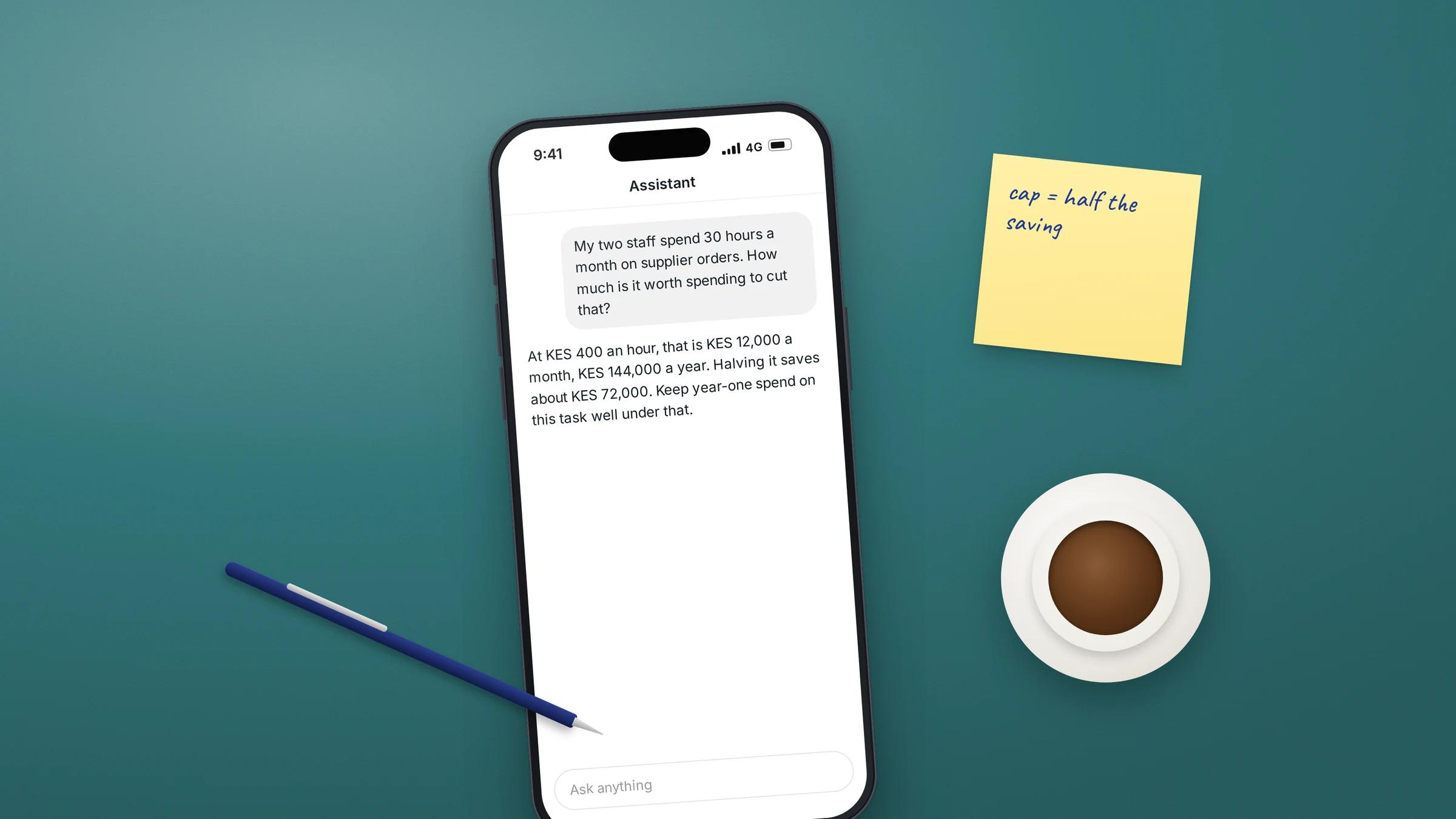
Cost per use. Once a rule is built, running it costs next to nothing. An AI feature has a cost every time it runs, because each request goes to a model that charges for the text it reads and writes. For one message that is tiny. For every message, every day, for a year, it adds up, and you should know the figure before you start. We broke down how in what it costs to run an AI feature, honestly.
Certainty. A rule does the same thing every time. If it is wrong, it is wrong consistently, and you fix it once. AI is usually right and occasionally wrong in a new way, which is why every AI step that matters needs a person to check it or a rule to catch its mistakes.
Use the cheapest thing that is reliably right. For predictable steps, that is a rule.
Some vendors wrap plain automation in AI language because it sells better. If a "smart" reminder system is really a scheduled message, that is fine, but you should not be paying AI prices or accepting AI uncertainty for it.
The best systems use both#
In practice, the useful pattern is AI at the messy edge and rules everywhere else.
For Njeri's bakery, it looks like this:
- A customer sends a voice note or paragraph. AI reads it and drafts a structured order: cake type, size, flavour, message on top, collection date and time.
- Njeri or her assistant checks the draft and taps confirm. A person decides.
- From then on, rules run everything: the kitchen list each morning, the deposit matched to the order, the reminder the day before, the thank-you after.
AI does one hard thing at the start. Rules do the ten easy things after. That is Stage 3 on the NGAZI ladder: AI working inside the workflow, with rules and people around it.
If you build it the other way, with AI deciding when to send reminders or what goes on the kitchen list, you pay more, get less certainty and gain nothing.
How to sort your own list#
Take any process that frustrates you and write every step on its own line. Next to each, write R for "the same every time", A for "needs understanding of messy language or images", or P for "needs a person's judgement".
Most owners find their list is mostly R, with one or two A's and a P or two. Start with the R's: they are cheaper, faster to build and easier to trust. Add AI only where the A's are slowing everything else down.
What to do this week#
Pick one process, list its steps and mark each R, A or P. If it is mostly R, ask whoever runs your system whether those steps can be scheduled or triggered today; many systems can already do it. If there is an A that eats hours, that is your first real AI project, and now you can describe it precisely.