Take an example bakery in Naivasha that set up an assistant to answer WhatsApp orders. It handles "do you have chocolate cake for Saturday?" beautifully. Then, one Saturday afternoon, a customer writes: "The birthday cake arrived broken. The party is in an hour. I paid KES 4,500 and I want my money back."
The assistant replies: "Thank you for your message! We're glad you chose us for your special day. Would you like to place another order?"
Nothing about that reply is technically wrong. It is a polite, friendly message. It is also the moment the customer screenshots the conversation and posts it.
Four kinds of message that need a person#
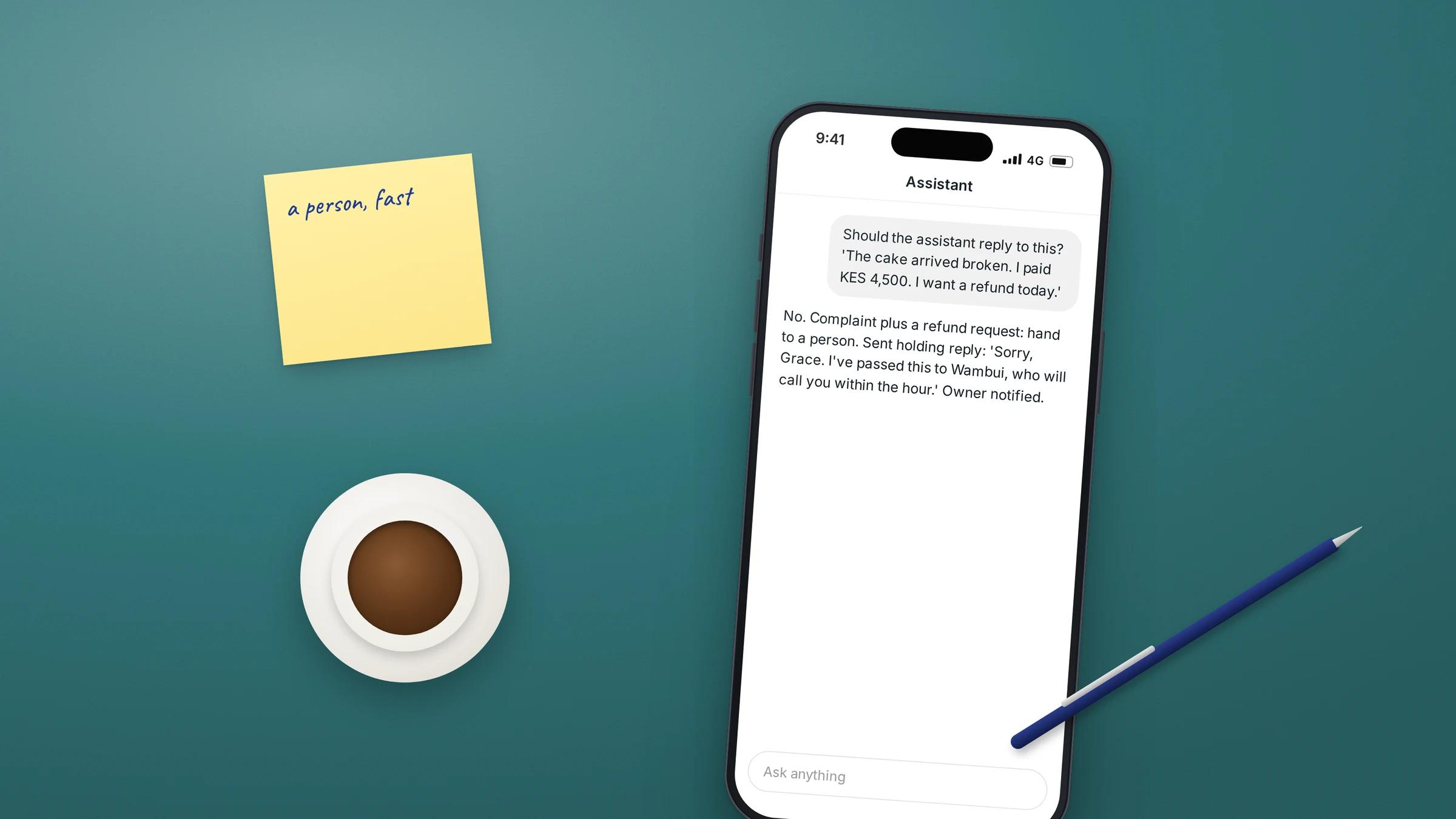
Complaints. Anything where the customer is unhappy: a broken item, a late delivery, rude service, a wrong order. The customer wants to feel heard by someone who can do something. A cheerful automated reply tells them nobody is listening.
Money disputes. "I paid but you say I haven't." "You charged me twice." "Where is my refund?" These need someone who can look at the M-PESA statement, decide, and take responsibility. An assistant that confirms a payment that never happened, or denies one that did, creates a problem that grows with every message.
Bad news. Delays, price increases, an item you cannot deliver after the customer paid, a cancelled booking. Also the human moments: a customer mentioning a death, an illness, a hardship. Bad news delivered by a machine feels like being brushed off, even if the words are right.
Legal threats and anything formal. "I'm going to report you." "My lawyer will contact you." A demand letter, a regulator's name, a journalist. Every word in a reply could matter later. These go to the owner, unanswered by the assistant, every time.
What the assistant does instead#
Hand-off is not silence. If the customer waits an hour with no response, the complaint gets worse. So for these four, the assistant has one narrow job:
- Recognise it. Words about refunds, broken, late, wrong, cheated, lawyer, police, report; strong emotion; capital letters; repeated messages. When in doubt, treat it as one of the four.
- Send a holding reply. Short, human, specific: "Sorry about this, Grace. I've passed your message to Wambui, who will call you within the hour."
- Alert a person. By phone notification or message, with the conversation attached, so they do not start from scratch.
- Stop. No further automatic replies in that conversation until a person hands it back.
AI can still help the person#
Taking the assistant out of the conversation does not mean taking AI out of the work. The person handling the complaint can ask an assistant to draft a calm apology, summarise a long angry thread, or set out the facts of a disputed payment. They then read the draft properly before anything is sent. Our sixty-second routine in how to check an AI answer in under a minute is exactly the right check for these drafts, especially the numbers and names.
The difference is who presses send. That is the same principle we apply to records in no silent writes: the machine prepares, a person decides.
Setting the rules#
This is the Stage 3 part of the NGAZI ladder: AI acting inside your process, within limits you set. Write the limits down before you switch anything on:
- Which topics the assistant may answer on its own (opening hours, prices from the list, stock, order status).
- Which it must hand over (the four above, plus anything not on the first list).
- Who receives hand-offs during opening hours and after them.
- The time within which a person will respond, and what the holding reply says.
Then test it. Send your own assistant ten difficult messages from a spare phone: an angry one, a "you charged me twice", a "my lawyer". See what it does with each.
What to do this week#
Look through last month's customer messages and find ten that fall into the four categories. For each, ask: if an assistant had replied automatically, what would it have said, and how would the customer have felt? Then write your holding reply and decide who receives the hand-offs. Do that before any assistant answers a single customer on your behalf.