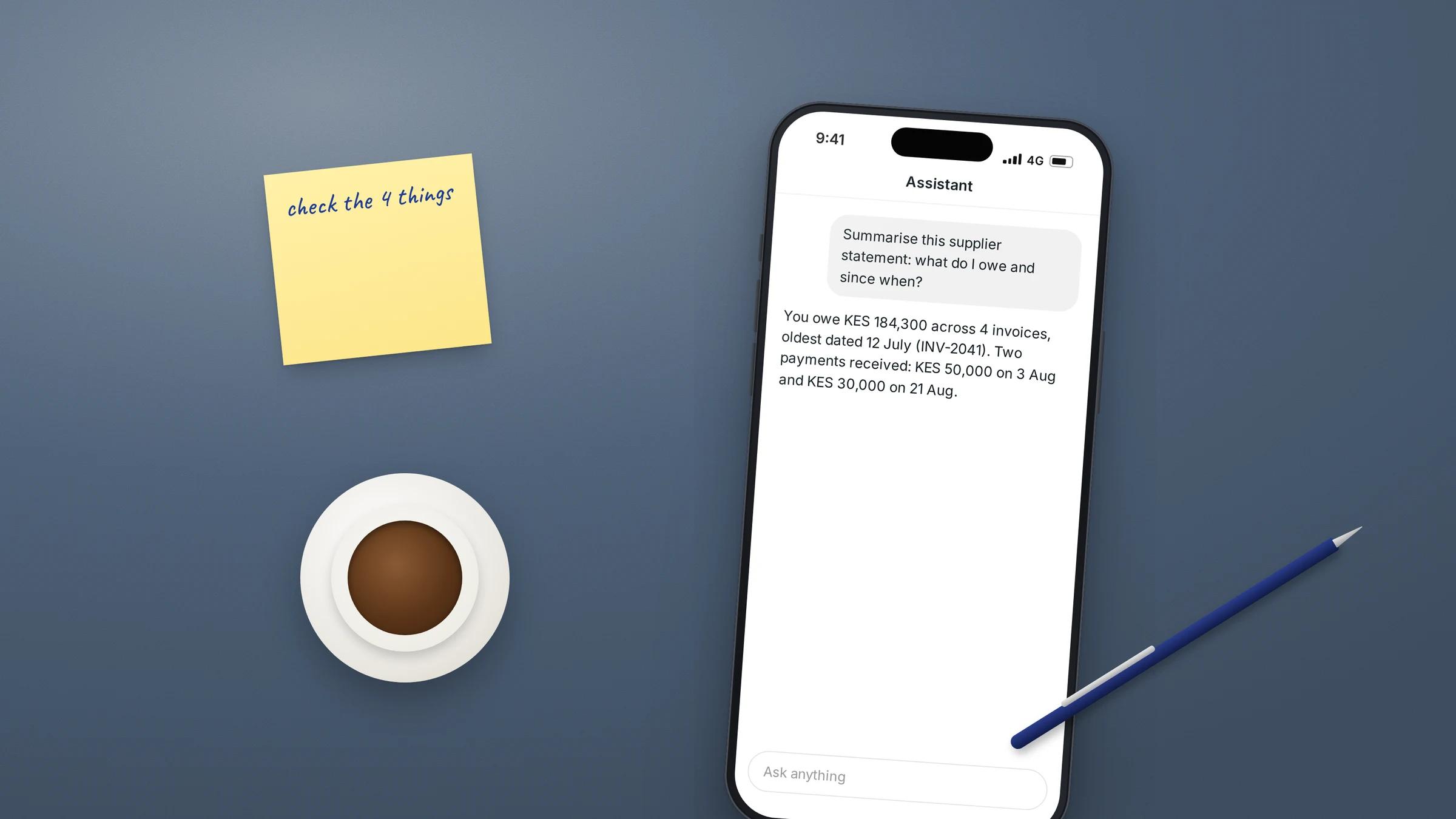
Take Muthoni, an example owner of a stationery wholesaler in Embu. Her main supplier sends a four-page statement every month. This month she pastes it into an assistant and asks: "What do I owe and since when?" The answer is clear and confident: KES 184,300 across four invoices, oldest from 12 July.
She is about to forward it to her bookkeeper when she glances at the statement again. The balance at the bottom says KES 148,300. The assistant swapped two digits. Everything else in the summary was right, which is exactly why the wrong part was easy to miss.
Why these four#
Assistants are very good at language: tone, structure, summarising the gist. They are much less reliable at reproducing exact details. A digit swaps, a name gets the wrong spelling, "next Friday" becomes the wrong date, and a plausible fact appears that was never in the document. These errors look exactly like correct answers. That is what makes them dangerous, and also what makes them easy to check: you know where to look.
The routine#
1. Numbers (20 seconds)#
Find every number in the answer: amounts, quantities, percentages, invoice numbers. Check each one against the original. Then re-add any total yourself, or at least check it roughly. In Muthoni's case, the four invoices on the statement add up to KES 228,300, and with KES 80,000 paid the balance is KES 148,300. The assistant's KES 184,300 does not survive the re-add.
If there are a lot of numbers, check the total and the largest two. Errors in small figures matter less than errors in big ones.
2. Names (10 seconds)#
Check every person, business, product and place. Is it spelt the way the original spells it? Is it the right one? Assistants sometimes merge two similar names, or "correct" an unusual spelling into a common one. A letter that addresses Mr Odhiambo as Mr Odiambo is a small embarrassment; a payment instruction to the wrong supplier name is not small.
3. Dates (10 seconds)#
Check every date and every relative time: "yesterday", "last month", "within 30 days". Relative dates are where assistants slip most, because they may not know today's date or may count from the wrong starting point. If the answer says "the oldest invoice is 12 July", find 12 July on the statement.
4. Sources (15 seconds)#
For anything stated as a fact that you did not give it, ask: where did that come from? If the assistant says "suppliers usually allow 60 days", that is not in the statement. It may be a guess. Either ask the assistant where it got it, or remove it. For anything that matters, an answer with no source is an opinion.
How much to check#
Not every answer needs the full minute. A suggested reply to "are you open on Sunday?" needs a glance at the hours. A summary of what you owe a supplier, a letter to a customer about money, or anything going into your records needs all four checks, every time.
A rough rule: if being wrong would cost you money, a customer or an awkward phone call, spend the minute. That rule belongs in your one-page AI policy if you have written one.
This is the core skill of Stage 1 on the NGAZI ladder: telling a good answer from a confident wrong one. It carries straight up to the stages where AI works on your own records, where the reasons for wrong numbers are different but the habit of checking is the same. We wrote about those reasons in why AI gives you confidently wrong numbers.
What to do this week#
Next time you use an assistant on anything with figures in it, run the four checks and time yourself. Write down anything you caught. After five answers you will know where your assistant tends to slip on your kind of work, and the routine will take less than the minute.