Take an example 40-flat block in Kilimani. In January the managing agent sends every tenant a one-line notice: "Service charge from February: KES 6,500 per month (previously KES 5,800)." Within a day the residents' WhatsApp group has two hundred messages. Someone is sure the guards are paid less than last year. Someone else saw the lift break down twice. By the end of the week, eight tenants have said they will pay the old amount until someone explains.
The increase may be completely fair. But a number with no explanation reads like a decision made somewhere else, by someone who does not have to pay it.
What tenants actually want to know#
When tenants question a service charge, they are rarely asking for a lower number. They are asking four questions:
- What does it pay for? Security, cleaning, the lift, the borehole pump, garbage collection, lights on the stairs.
- How is my share worked out? Equal per flat, or by size?
- What changed? If it went up, which line went up and why.
- Can I see where the money went? Last year's spending against last year's budget.
A notice that answers all four rarely starts a group-chat storm.
Build the breakdown first#
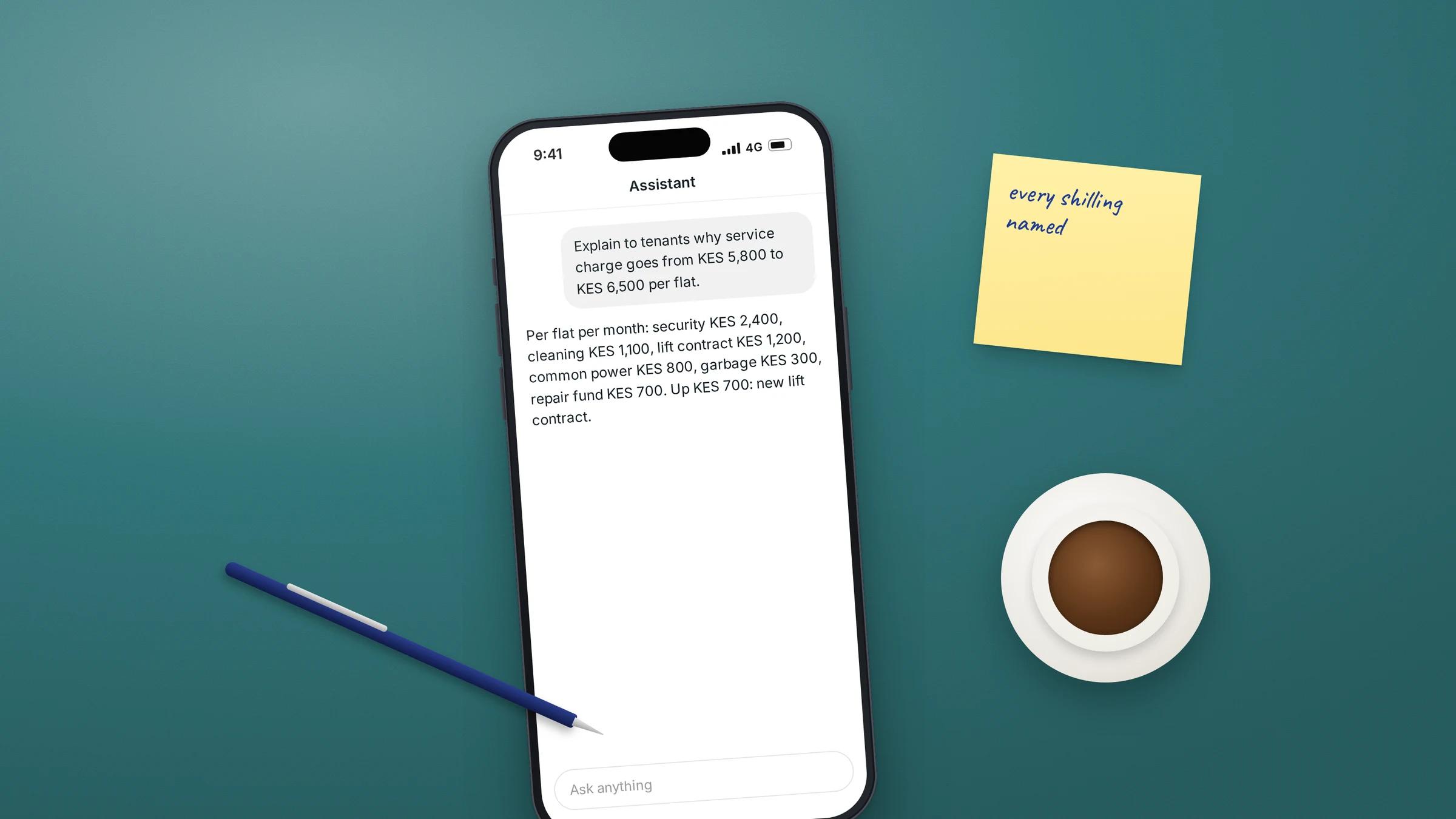
Before writing anything, put the year's budget into a simple table: each item, the annual cost, and the cost per flat per month. For the Kilimani block, that might look like this:
| Item | Per flat per month |
|---|---|
| Security (two guards, day and night) | KES 2,400 |
| Cleaning of common areas | KES 1,100 |
| Lift maintenance contract | KES 1,200 |
| Common area electricity and borehole pump | KES 800 |
| Garbage collection | KES 300 |
| Repair fund for roof, pumps, painting | KES 700 |
| Total | KES 6,500 |
Say how it is shared. "Equal for every flat" is simple; "by floor area" needs one more line showing the sizes. Either is fine. Hiding the method is not.
Then the change: last year's total was KES 5,800. If the increase is the new lift contract, say so, with the old and new figures. If two lines went up and one went down, show all three.
Let an assistant write the letter#
This is where Stage 1 of the NGAZI ladder is genuinely useful. You have the facts in a table; turning them into a clear, calm letter is the part most managers put off. Give an assistant the table and a brief:
I manage a 40-flat residential block in Kilimani. Write a letter to tenants explaining the service charge for next year. Here is the breakdown [paste table]. Last year it was KES 5,800; the increase is mainly the new lift maintenance contract, which went from KES 20,000 to KES 48,000 a month for the block. Plain English, friendly, under 300 words. End by offering a residents' meeting and a copy of last year's accounts.
If you have not briefed an assistant like this before, our guide to writing a prompt the way you would brief a new employee explains the four parts.
Then check every figure in the draft against your table. Assistants are good at tone and occasionally careless with numbers. A letter explaining money that gets the money wrong does more damage than no letter.
Do not paste tenant names, flat numbers with names, or anyone's arrears into the prompt. The letter is about the building, not about people.
Report back, every year#
The explanation in January earns trust once. What keeps it is a short report at the end of the year: budget against actual for each line, the repair fund balance, and anything unusual. One page is enough. Send it whether the numbers came in under or over.
Leases and any rules for the block may set out how service charges are set and reported. Check yours, and take professional advice on anything formal.
What to do this week#
Take your current service charge and write the table: each item, per flat per month, and how the share is calculated. If you cannot fill a line from records, that is the first thing to fix. Then use an assistant to draft the letter, check every number, and send it before the next charge is due, not after the complaints start.