Imagine your first morning at a new job. The manager walks past and says, "Write something for the customers about the uniforms." Then leaves.
You would have questions. Which customers? Which uniforms? Is this a price list, a reminder, an apology? How long should it be, and where will it be posted? A sensible new employee would go and ask. An AI assistant will not ask. It will guess, write something polite and generic, and you will decide AI is not very good.
Most disappointing AI answers come from this exact situation. The fix is to brief the assistant the way you would brief a capable new hire on their first day.
The before#
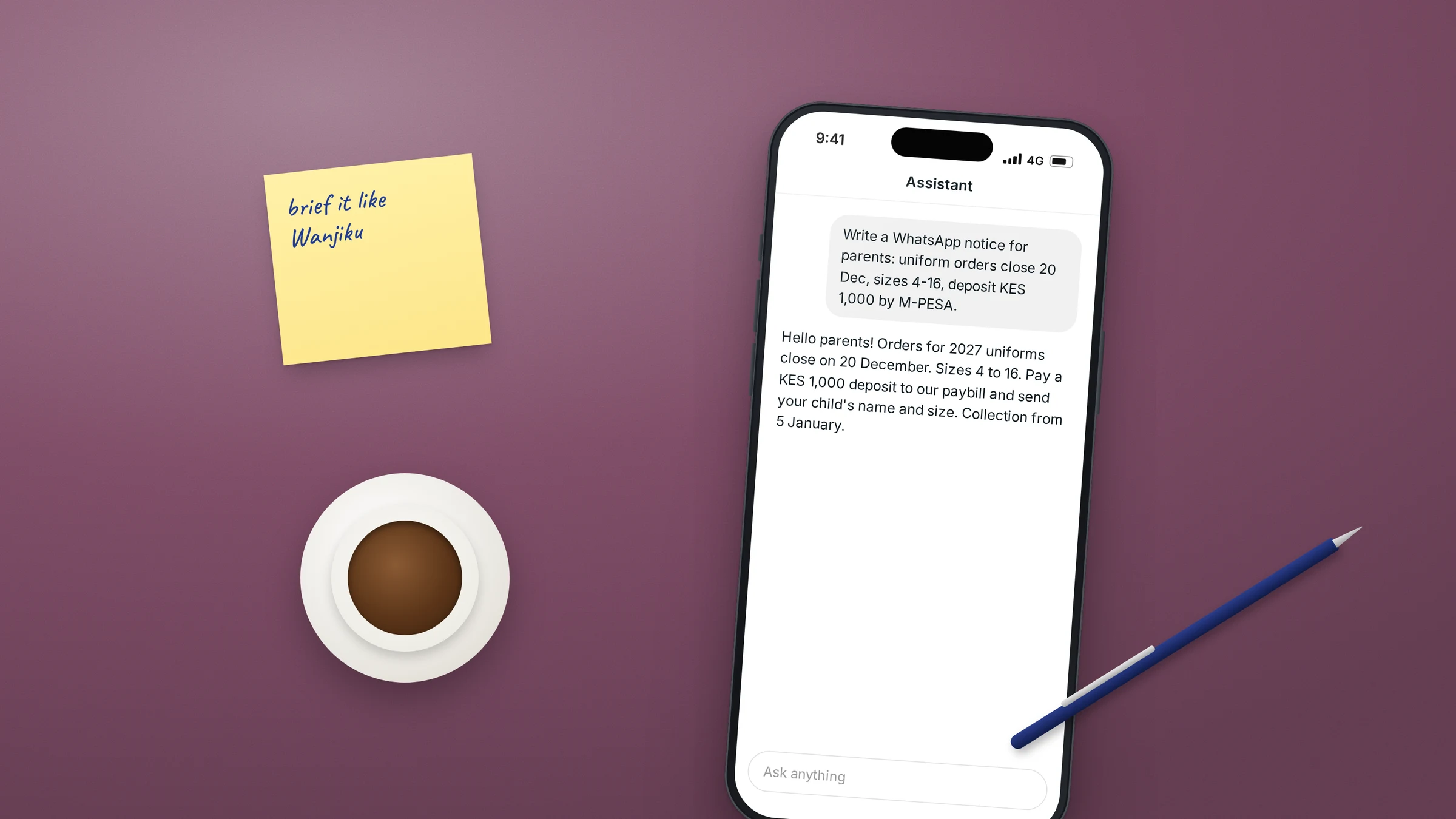
Take a tailoring business in Nakuru that makes school uniforms. Every November the owner, Wanjiku, needs to tell parents that orders for the new school year are open. Here is a first attempt:
Write a message about school uniform orders.
The assistant returns three paragraphs about "quality uniforms for your little ones", invents a 10% discount, and ends with "contact us today". It is not wrong exactly. It is just not Wanjiku's business, because nothing in the prompt was.
The four parts of a good brief#
1. Context: who you are and who it is for. What would a new employee need to know before writing anything? "I run a small tailoring business in Nakuru. We make school uniforms for four local primary schools. Most of our customers are parents who know us already and message us on WhatsApp."
2. Task: one clear job. "Write a WhatsApp message announcing that uniform orders for the 2027 school year are open." One job per prompt. If you also want a poster, ask for it next.
3. Example: what good looks like. This is the step people skip and the one that changes the most. Paste last year's message, or a message you liked from someone else, and say what you liked about it. "Here is last year's message. Parents liked that it was short and gave the deadline first."
4. Format: the shape of the answer. Length, language, tone, what to include, what to leave out. "Under 60 words. Friendly but not cute. English, with a short Swahili version underneath. Include: closing date 20 December, sizes 4 to 16, deposit KES 1,000 by M-PESA, collection from 5 January. No discounts, we are not offering any."
The after#
Put together, the brief reads like this:
I run a small tailoring business in Nakuru. We make school uniforms for four local primary schools, and our customers are mostly parents who already know us and message us on WhatsApp.
Write a WhatsApp message announcing that uniform orders for 2027 are open.
Here is last year's message, which parents liked because it was short and put the deadline first: [pasted message].
Under 60 words, friendly but not cute, English with a short Swahili version underneath. Include: orders close 20 December, sizes 4 to 16, KES 1,000 deposit by M-PESA, collection from 5 January. Do not mention discounts.
That took Wanjiku about two minutes to write. The draft that came back needed one change. The first draft needed rewriting from scratch.
Keep the briefs that work#
A good brief is reusable. Wanjiku's context paragraph will be the same next month when she writes to parents about collection days, and the month after that when she writes to a school about a bulk order. Keep a note on your phone called "briefs" with the context paragraph at the top and each task that worked underneath.
This is the habit that Stage 1 of the NGAZI ladder is really about. Briefing clearly and judging the result are skills, and they carry straight up to every later stage, including the ones where AI works on your own records.
If your business has an AI policy, add this to it: briefs may describe the business, but never paste customer lists or personal details into them. We wrote a one-page template for exactly that.
What to do this week#
Pick one message you send regularly: a reminder, a price change, a delivery note. Write the four-part brief for it. Context, task, example, format. Run it, fix the draft, and save the brief.
Next time you need that message, paste the saved brief, change the details and send. That is the moment a prompt stops being an experiment and becomes a tool. For more on the messages most businesses send every week, see write supplier and customer messages in two minutes.