Think of a distribution business with eight drivers on the road. Every day each one buys fuel, pays a parking attendant, sometimes fixes a puncture. Under the old routine, receipts went into an envelope, the envelope went to the supervisor on Friday, the supervisor signed a summary sheet, the accountant checked it against the receipts, and the director signed again before anyone was reimbursed. A driver who paid for a tyre from his own pocket could wait two weeks.
Nobody designed that chain to be slow. Each signature was added after a mistake: a receipt claimed twice, a figure misread, a purchase nobody remembered approving. The chain grew because no single person trusted what reached them.
The example business is illustrative, but the pattern is common. This piece walks through how UpeoXpense approaches approvals, and what any business can take from it.
Why chains get long#
An approver is really being asked three questions:
- Is this real? Was the money actually spent, and is this the actual receipt?
- Is it right? Are the amount, date, VAT and vendor correct?
- Should we pay it? Is this a reasonable business expense?
Only the third question needs a manager's judgement. The first two are checks. When a business has no reliable way to answer them before the paper reaches the manager, it adds people: a supervisor to confirm it is real, an accountant to confirm it is right, a director to decide. Three signatures for one decision.
The way to shorten the chain is to answer the first two questions before anyone with authority looks at the claim.
What happens before the approver sees anything#
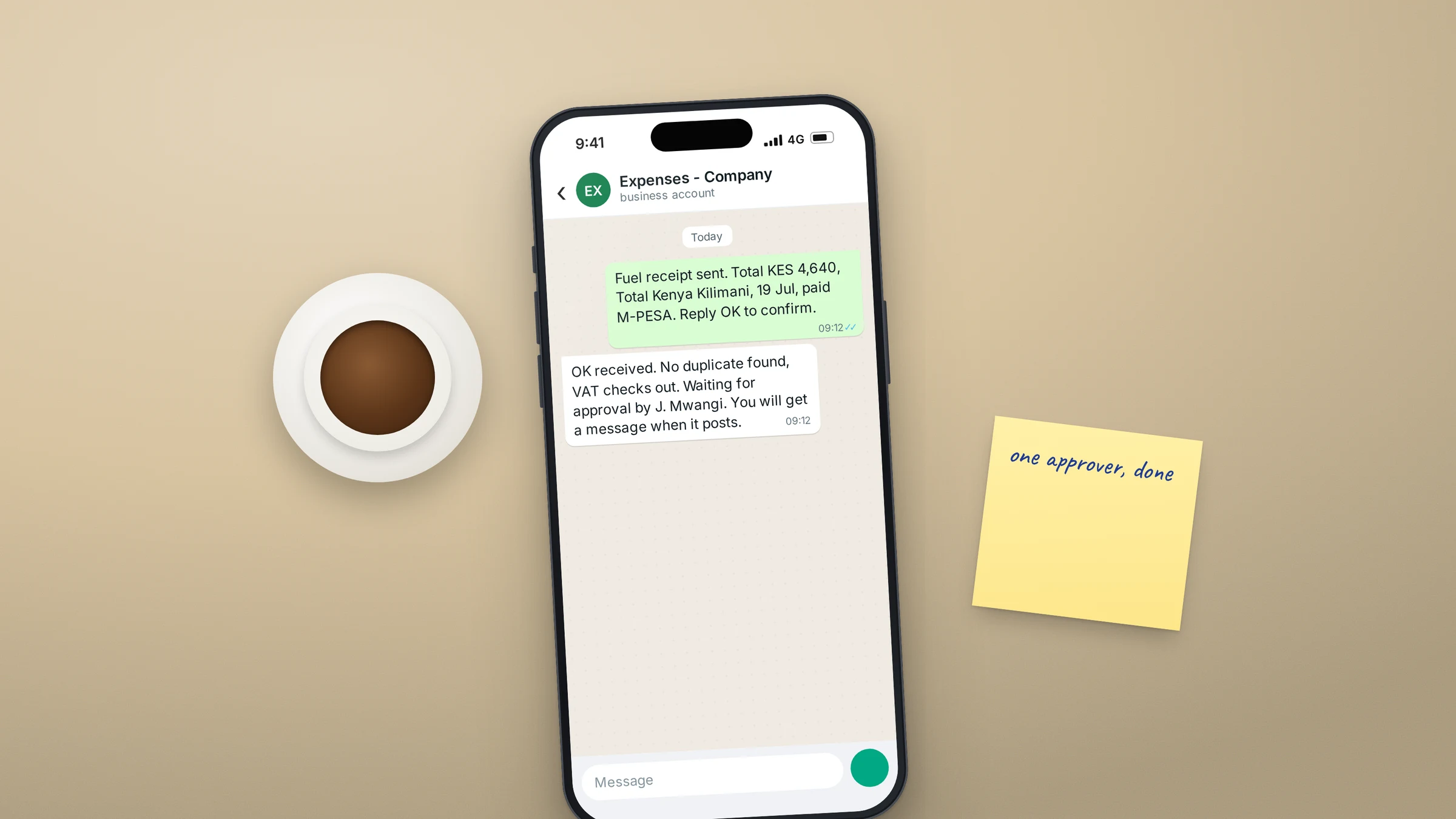
In UpeoXpense, the staff member sends a photo of the receipt to the company WhatsApp number. Then, before any manager is involved:
- The sender's number is matched to an employee. Unknown numbers are ignored.
- The image is fingerprinted, so the same receipt, or a re-photographed copy of it, is caught as a duplicate.
- AI reads the receipt: vendor, date, amount, VAT, KRA PIN, payment method.
- Plain code, not the AI, checks what was read: the amount is above zero, the VAT reconciles, the date is sane, the PIN has the right format.
- The sender gets a summary on WhatsApp and replies
OK, a corrected figure,CLAIMif they paid personally, orNOto discard.
By the time the claim reaches a manager, the "is it real" and "is it right" questions have been worked through by rules anyone can read, and the person who spent the money has confirmed the figures. What is left is the decision.
Checks belong to the system. Judgement belongs to a person. Most long approval chains are people doing checks.
One approver, with the evidence in front of them#
The manager works from a single queue in a web dashboard. Each item shows the original receipt image beside the extracted fields and the category. The manager can approve, reject, correct, or mark it for reimbursement. On approval, the Journal Entry posts to ERPNext on its own: company-paid expenses are recognised against petty cash straight away, and employee-paid ones are held as owed to the employee until the reimbursement is paid.
Two things make this a fast step rather than another bottleneck. The approver never has to find the receipt, because it is on the screen. And the approver never has to retype anything, because approval is the posting.
Designing your own chain#
You may not use UpeoXpense, and your business may genuinely need more than one approver for some expenses. The design questions are the same:
Separate checks from decisions. List what each person in your current chain actually does. If a step is "make sure it is not a duplicate" or "make sure the sum is right", that is a check a system can do.
Put the evidence with the request. An approver who has to ask "where is the receipt?" will hold the claim until it turns up.
Give each approver a deadline and a queue. A claim waiting in a queue is visible. A claim in an envelope on a desk is not.
Add levels for size, not for distrust. If large or unusual expenses need a director, make that a rule based on amount or category, so ordinary fuel claims never wait for the director. Designing approval steps for AI that writes to your records goes deeper on where to put the human.
What to do this week#
Take last month's expense claims and pick ten at random. For each, write down how many days passed between the money being spent and the claim being approved, and who touched it in between. Then mark each step as a check or a decision. If more than half the steps are checks, you have found where the time goes, and which steps a system could take over.