Picture an electrical supplies shop in Nyeri on a busy Saturday. A contractor buying cable and switches for a building job asks for a receipt with his company's KRA PIN on it, because his client will need it. The cashier is not sure where to enter the PIN, the queue grows, and the receipt that eventually prints has the contractor's name spelled two different ways. Ten minutes later the network drops, and nobody is sure whether the sales being rung up are producing receipts at all.
None of this is a question of tax law. It is a question of whether the shop's system and habits are ready for the receipts the shop needs to issue.
This article is not tax advice. eTIMS is KRA's electronic tax invoice system, and the details of who must use it, how, and in what form are set by KRA and can change. Check KRA's current guidance, and talk to your accountant or tax adviser about what applies to your business. What follows is the practical, system side: what a shop owner should expect from the software at the counter.
Clean items come first#
A tax invoice lists what was sold. If your items are a mess, your receipts will be too. Before anything else:
- Every item has a clear name a customer or an auditor could understand. "CBL 2.5 RD" means something to your staff; "Cable 2.5mm red, per metre" means something to everyone.
- Every item has its tax set-up done, in the way your accountant confirms is right for that item. Your system should not let an item be sold without it.
- Units of measure are consistent, so a receipt shows "15 metres" rather than "0.15 rolls". If you sell in several units, see selling by the bag, the piece and the metre.
Setting this up once is a Stage 0 job on the NGAZI ladder: getting the business written down properly. Everything that follows depends on it.
What to ask of the counter system#
When you choose or review a retail system, ask the provider to show you each of these during a demo rather than only confirming them on a call:
- Every sale produces its receipt as part of the sale, without a second step or separate machine that staff can forget.
- Customer PIN capture is quick. Repeat business customers should be saved, so their name and PIN are picked from a list, not retyped.
- The receipt record is stored with the sale, including whatever reference or confirmation the tax system returns, so you can find it months later from the sale.
- Returns and corrections are done properly, through a credit note linked to the original sale, not by deleting or editing the sale.
- Failed submissions are visible. If a receipt could not be issued for any reason, the system should say so clearly and keep the sale in a queue to retry.
- Reports match. Your sales report and your receipts report for a day should agree, and the system should show you any difference.
Plan for the network going down#
Kenyan shops lose connectivity. Power goes, the router restarts, the mobile data runs out. How does your system behave when that happens mid-sale?
Ask your provider exactly what happens to receipts when the system is offline, how long it can stay offline, and how you will know when everything has caught up. Then test it: pull the network cable on a quiet afternoon, ring up a test sale, plug it back in, and watch what happens. What KRA requires for offline situations is for KRA's guidance and your adviser; whether your system handles it visibly is for you to check.
A daily check that takes two minutes#
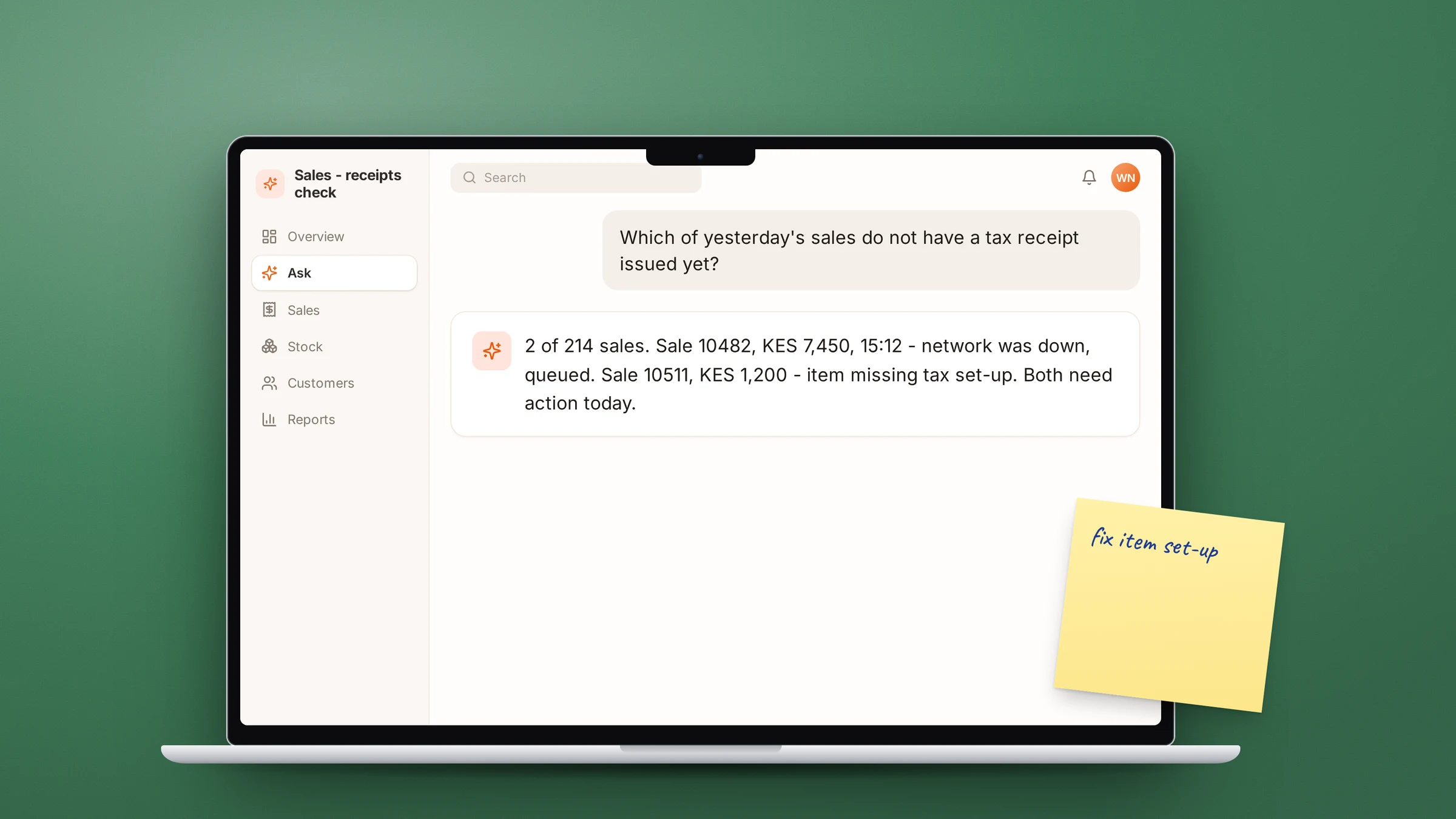
At the end of the day, or first thing next morning, look at one thing: are there any sales without a successfully issued receipt? A good system can show this as a short list. Every item on it should have a reason and an action, as on the screen pictured above. An empty list is the goal; a short list dealt with daily is fine; a long list nobody reads is a problem growing quietly.
If your sales are still in a book, start with getting them out of the exercise book. A system cannot issue receipts for sales it never recorded.
What to do this week#
Take your twenty best-selling items and check three things for each in your system: the name is clear, the tax set-up has been confirmed with your accountant, and the unit is right. Then ask a cashier to ring up a sale for a business customer with a PIN, and time it. If either check shows problems, you have your list for next week, and a precise set of questions for your accountant and your system provider.