Take a hardware shop on the Kitengela road, run by a man I will call Otieno. In one morning he sells a full roll of chicken wire to a farmer, eleven metres of the same wire to a man fencing a small garden, and a box of 3-inch nails plus two kilos of loose ones to a fundi. At closing time he writes "wire" and "nails" in the book, and he has no idea how much of either he has left.
That is not carelessness. It is the hardest part of running a hardware shop: the same item leaves the shop in different sizes, and paper cannot keep track of the conversions. Before any software, AI or otherwise, can tell Otieno anything useful, this has to be written down properly. That is Stage 0 on the NGAZI ladder, and in a hardware shop it is mostly about units.
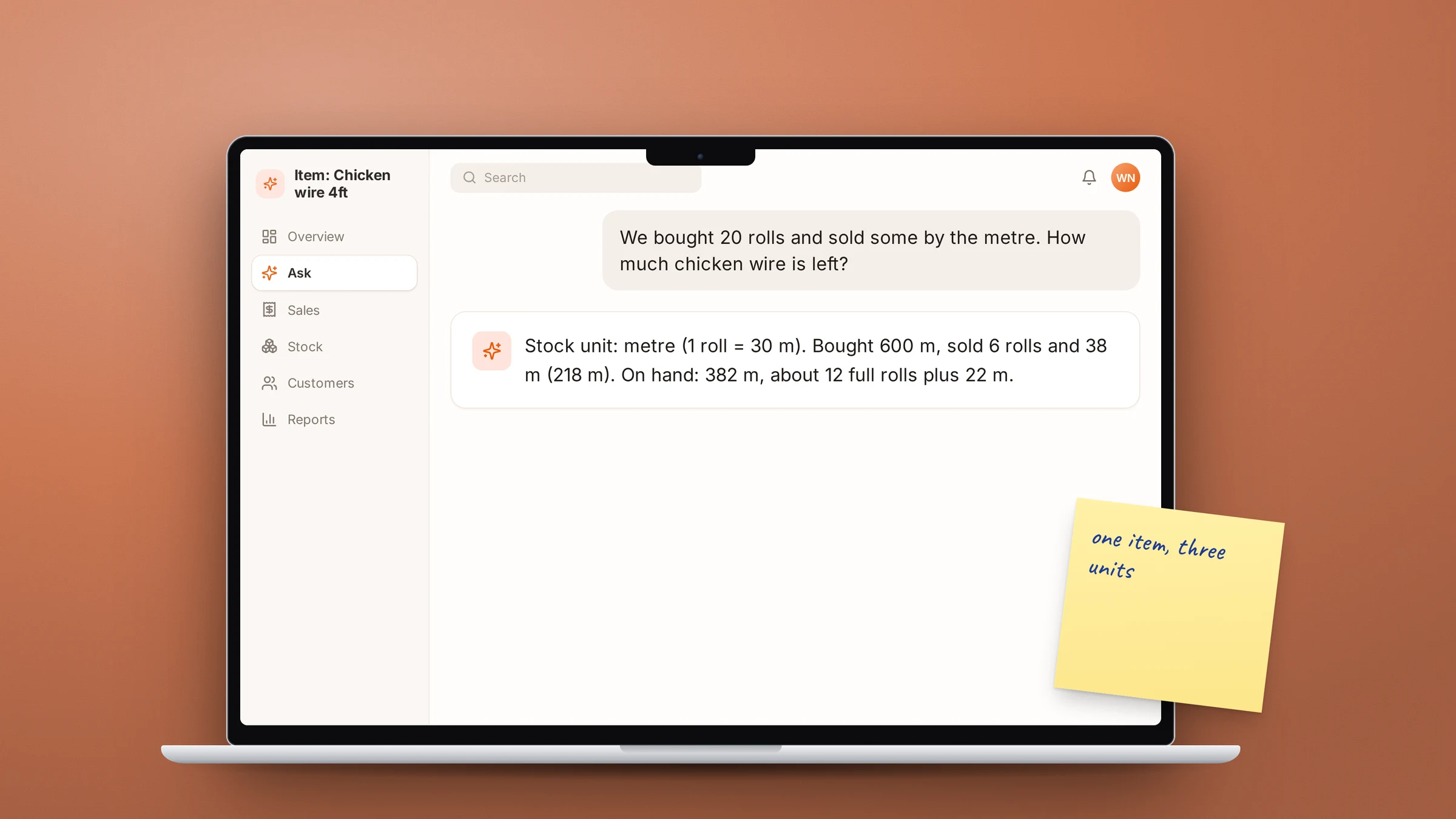
One item, one stock unit#
The rule that fixes most of the confusion is simple: every item has exactly one unit it is counted in. Everything else is a conversion to that unit.
Pick the unit you buy in or the smallest unit you sell in, then stick to it:
- Cement: counted in bags. You never sell half a bag, so this one is easy.
- Nails: counted in kilograms. A box is a known number of kilos; loose nails are weighed.
- Chicken wire and binding wire: counted in metres. A roll is a known number of metres.
- Paint: counted in litres, with tins of 1, 4 and 20 litres as conversions.
- Iron sheets: counted in pieces, because each sheet is sold whole, even when priced by gauge and length.
The mistake I see most is a shop creating separate items for "Nails 3 inch box" and "Nails 3 inch loose". Now there are two stock counts for one physical pile of nails, and they drift apart the first time someone opens a box to sell loose.
Write down the conversions, once#
Once the stock unit is fixed, each other way of selling becomes a line in a small table. For Otieno's chicken wire it might look like this:
| Sold as | Equals |
|---|---|
| 1 metre | 1 metre (stock unit) |
| 1 roll | 30 metres |
| Half roll | 15 metres |
Good retail systems, including ERPNext, which UpeoRetail is built on, hold this as a stock unit plus a list of other units with a conversion factor each. When the cashier sells "1 roll", the system takes 30 metres off the count. When she sells 11 metres, it takes 11. The number on the screen is always in metres, so it can always be compared with a physical count.
The conversion has to match what your supplier actually delivers. If one brand's roll is 30 metres and another's is 25, those are two items, not one. Measure a roll before you trust the label.
Price per unit, not per guess#
Units of measure also fix pricing. When nails are counted in kilograms and the box is 5 kg, you can see straight away whether the box price makes sense against the loose price. Say loose nails sell at KES 220 per kg and a 5 kg box at KES 1,000. That box is cheaper per kilo, which may be exactly what you want for fundis who buy in bulk. But it should be a decision, not an accident from two prices set on different days.
Set a price for each unit you sell in. The system then shows you the price per stock unit side by side, and the odd ones stand out.
Selling an opened roll#
The awkward moment is the first metre cut from a new roll. On paper, the roll disappears from the shelf count while 29 metres are still sitting there. In a system that counts in metres, nothing special happens: 30 metres became 29.
The habit that matters is labelling. Put a tag on the opened roll with the metres left after each cut. When the system says 47 metres of chicken wire and you have one full roll and one tagged at 17, you can check it in ten seconds.
What to do this week#
You do not need new software to start. Take a sheet of paper and list your twenty fastest-moving items. For each, write:
- The stock unit you will count it in.
- Every other way you sell it, and how many stock units that equals.
- The price for each of those ways.
Then count those twenty items in their stock unit. That list is the first real record of your stock, and it is exactly what any system will ask you for on day one. If your sales still live in an exercise book, this guide to getting them out of it is the companion step.
Once units are right, the questions owners actually ask start to have answers: which wire gauge is slow, whether loose nails make more than boxed ones, when to reorder cement before the rains. None of those can be answered while "wire" in the book means three different things.