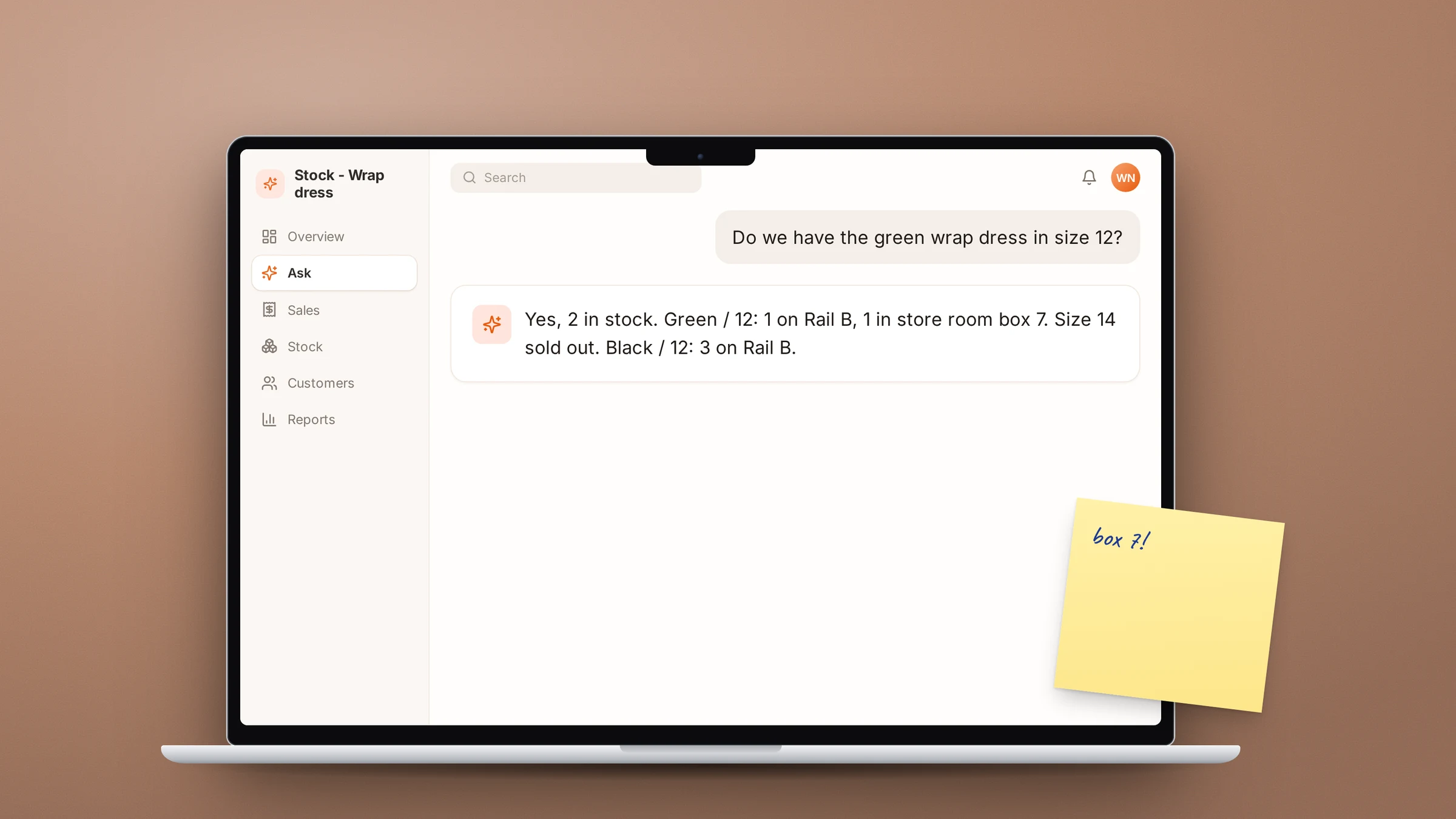
Take Halima, who runs a boutique in a mall on Moi Avenue in Mombasa. On a Saturday a customer asks for the green wrap dress in size 12. The attendant checks the rail: 10, 14, 16, no 12. "Sorry, we're out." On Tuesday, unpacking a box in the store room, Halima finds two green size 12s that came in with the last delivery. The customer bought elsewhere. The dresses will sit until the end of the season and go on sale.
This is the most common way boutiques lose money, and it has nothing to do with fashion sense. It is a recording problem. The shop knows it has "the wrap dress". It does not know it has a green size 12 in box 7.
One style is many items#
The root of the problem is how stock is written down. Many boutiques record a style once: "Wrap dress, KES 3,500, qty 24". But the customer never asks for "a wrap dress". She asks for a colour and a size, and of the 24, maybe only one is the one she wants.
The fix is to record every combination as its own item, called a variant:
| Style | Colour | Size | Qty |
|---|---|---|---|
| Wrap dress | Green | 10 | 2 |
| Wrap dress | Green | 12 | 2 |
| Wrap dress | Green | 14 | 0 |
| Wrap dress | Black | 12 | 3 |
Four sizes in three colours make twelve lines. That feels like a lot of writing for one dress, and for the first week it is. But every question you actually need answered, "do we have it in a 12?", "which sizes sell out first?", "what is left at the end of the season?", lives at this level, and nowhere else.
Most retail systems handle this with a parent item (the style) and variants underneath it (each colour and size). If your system does not, it is worth asking why before you go further.
Give every item a place#
Recording variants tells you the stock exists. It does not tell you where it is. Boutiques usually have three places: the shop floor, the store room, and sometimes the window or a mannequin. Stock goes missing between them.
Simple habits fix most of it:
- Name every rail and shelf with a letter or number on a card: Rail A, Rail B, Shelf 3.
- Number the store-room boxes and write the style, colour and sizes on each.
- Record the location alongside the quantity, even if it is only on a printed stock sheet.
- Move stock deliberately: when you take two pieces from box 7 to Rail B, change the sheet.
It sounds fussy. It is the difference between "we're out" and "give me one minute".
What variants tell you once they are recorded#
After a season of recording sales by variant, the shop starts to show you things feel cannot:
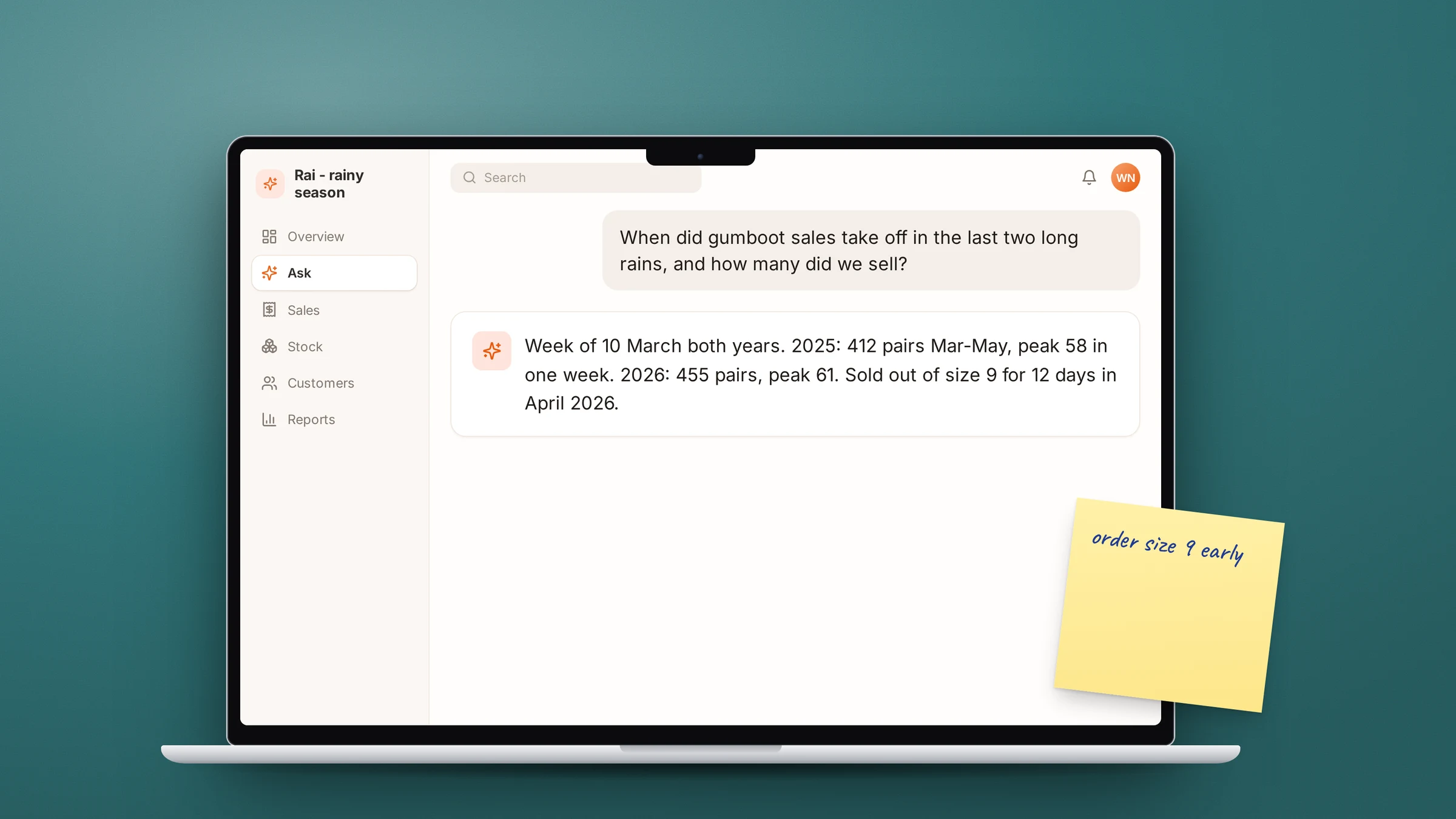
- Sizes that sell out first. If size 12 always goes in the first two weeks and size 16 is always on sale at the end, your next order should not have the same number of each.
- Colours that do not move. If the mustard sells half as fast as the black every time, buy less mustard.
- Dead stock by variant. The style may be selling well while three particular pieces have sat for four months. Our piece on dead stock explains how to find and clear them.
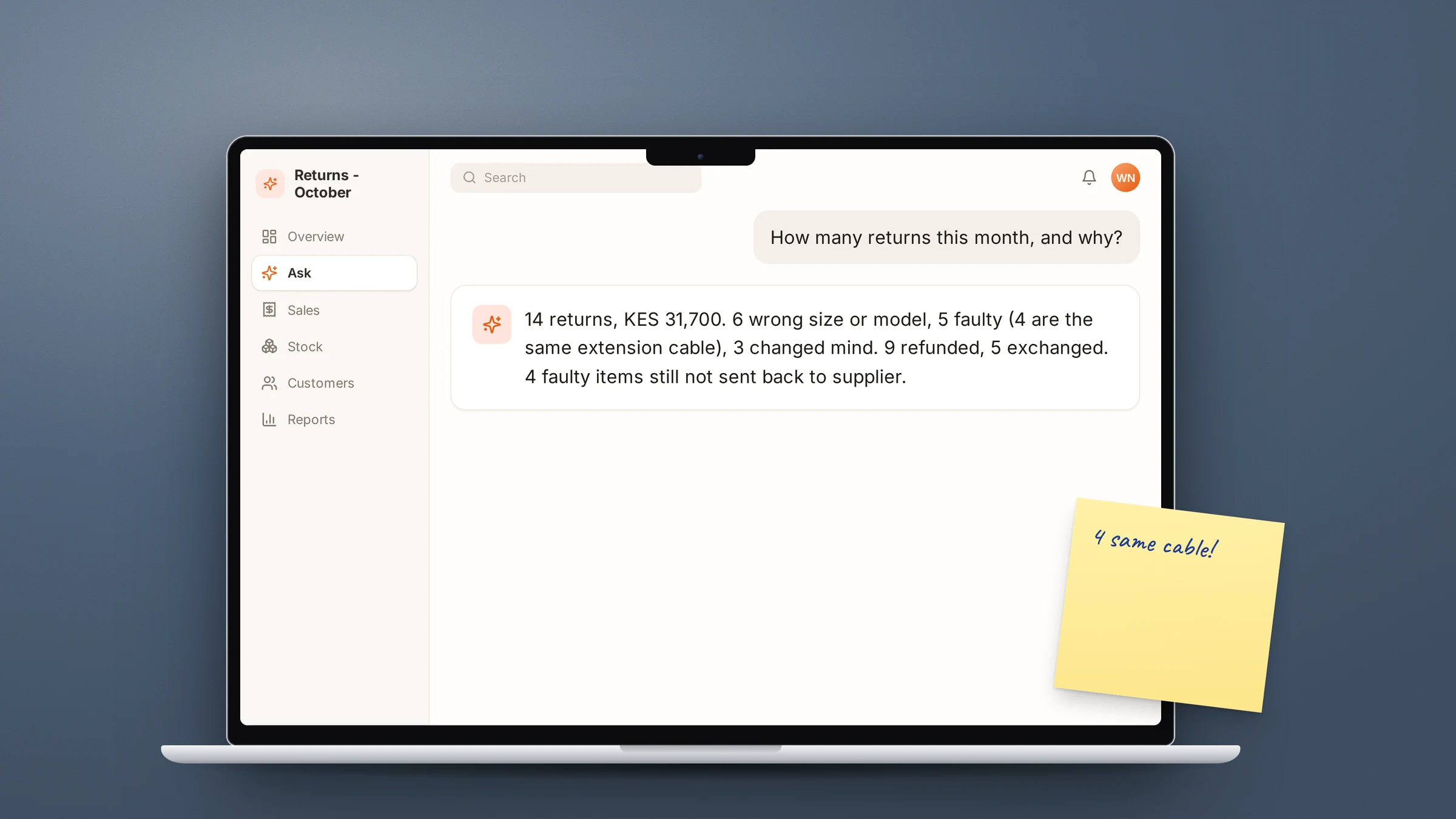
Returns and exchanges need the same care: a customer who swaps a 12 for a 14 changes two lines, not none.
Why this comes before AI#
People ask whether AI can tell a boutique what to buy next season. With variant-level sales history, it can help a lot. Without it, it has nothing to read but totals, and totals hide exactly the thing that matters. That is why this is Stage 0 on the NGAZI ladder: getting the business written down in a form that can be counted.
What to do this week#
Choose your five best-selling styles. Count every piece by colour and size, on the floor and in the store room, and write down where each one is. Put a letter on every rail and a number on every box. From then on, record each sale of those styles by colour and size. In a month you will know which sizes you run out of, and you will stop telling customers you are out when you are not.