Say an electrical and hardware shop in Machakos sells an extension cable. A customer brings one back the next day: it does not work. The attendant, being helpful, takes it back, hands over KES 1,200 from the drawer and puts the cable under the counter. Nothing is written down.
Look at what just happened to the shop's numbers. The sales book still shows the cable sold, so sales are KES 1,200 higher than they really are. The drawer is KES 1,200 short at cash-up, so it looks like a loss or a theft. Stock records say the cable is gone, but it is under the counter, faulty, and nobody has told the supplier. Three records, all wrong, from one kind gesture.
Returns are a normal part of trading. The problem is not the return; it is the missing record.
Why unrecorded returns matter#
A shop with a handful of returns a week, none recorded, will see:
- Sales that are too high. Every refunded sale still counts. Your margin reports and your sense of what sells are both inflated.
- Cash-ups that never balance. Refunds from the drawer look exactly like shortages. If you do a daily cash-up (see daily cash-up in ten minutes), unrecorded refunds will appear as unexplained shorts, and an honest attendant may be blamed.
- Stock that is wrong both ways. Good returned items are back on the shelf but not in the records; faulty ones sit in a corner and are never claimed from the supplier.
- No warning about bad products. If one item keeps coming back, you only find out if returns are counted.
Unrecorded returns are also a known route for shrinkage: a fake "refund" from the drawer leaves no trace. We looked at that in shrinkage: what your records already say about missing stock.
What a return record needs#
Whether you use a book, a spreadsheet or a system, every return gets one line:
| Field | Example |
|---|---|
| Date | 14 Oct |
| Original sale | Receipt 0873, 13 Oct |
| Item and quantity | Extension cable 4-way, 1 |
| Amount | KES 1,200 |
| Reason | Faulty: no power |
| What the customer got | Refund cash / M-PESA / exchange / credit |
| Where the item went | Back to shelf / faulty shelf / supplier |
| Approved by | Name |
The two most important fields are original sale and reason. Linking to the original sale proves the item was bought from you and at what price, which stops refunds at the wrong price. The reason is what turns a pile of returns into information.
Credit notes: the proper word for it#
In a till system or accounting software, a return is recorded as a credit note (sometimes called a sales return). It is a document that reverses all or part of a sale: it reduces sales, puts the item back into stock if you choose, and records the money going back or the credit owed to the customer.
If your shop issues electronic tax receipts, returns may need a matching credit note in that system too. The rules for that are KRA's, and they change, so check current eTIMS guidance or ask your accountant how returns should be handled in your setup.
Three rules make credit notes work:
- Never edit or delete the original sale. Reverse it with a credit note. The history should show both: it was sold, then it came back.
- Choose where the stock goes. Resaleable items return to normal stock. Faulty ones go to a separate "faulty" or "returns" location, so they are not sold again and can be claimed from the supplier.
- Refund the way they paid, where possible. M-PESA purchases refunded by M-PESA leave a clean trail. Cash refunds should be noted in the drawer count.
Read your returns once a month#
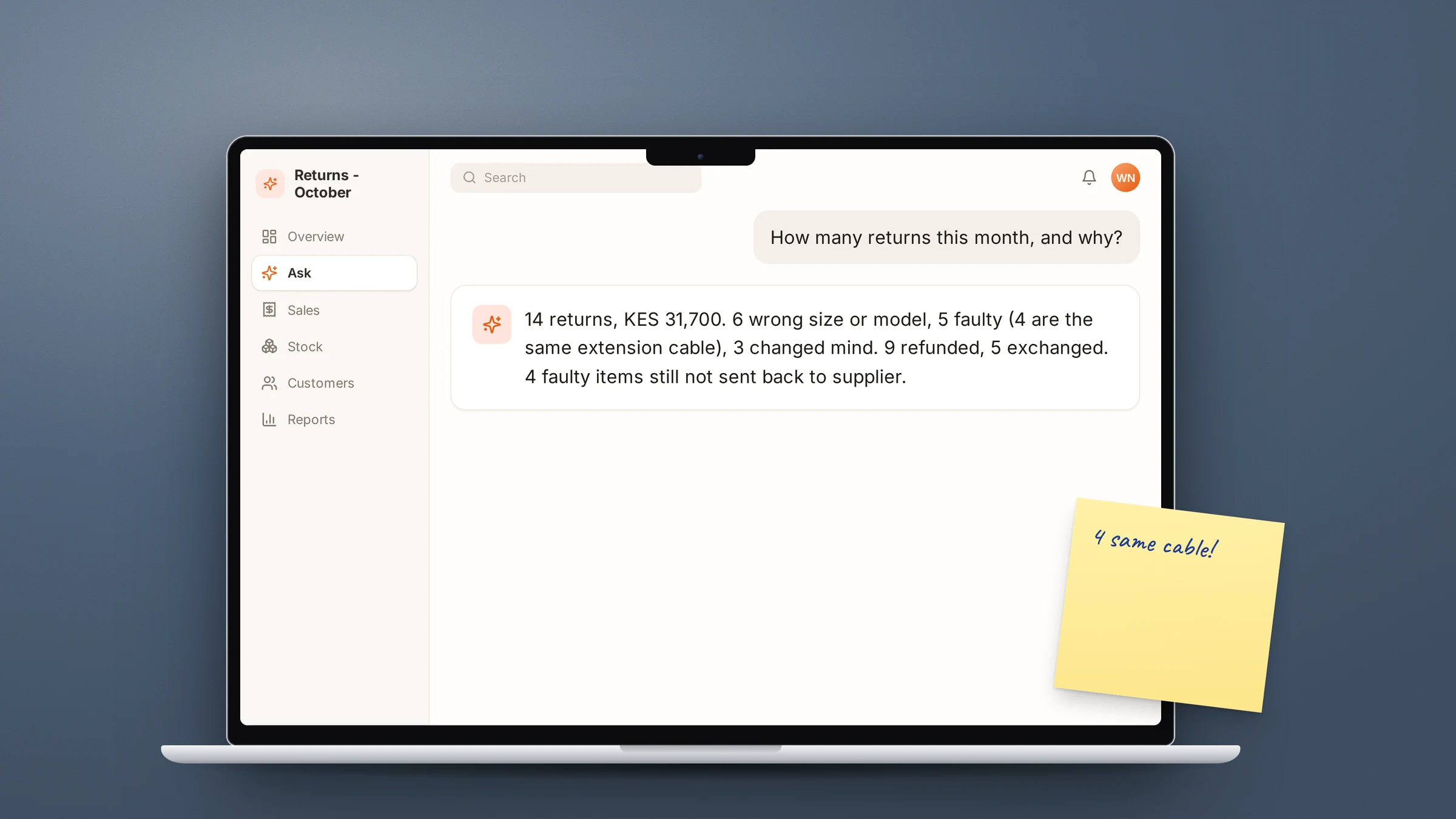
Once returns are recorded with reasons, a five-minute monthly look tells you a lot:
- Faulty, by product. The same item coming back repeatedly is a supplier conversation, with evidence.
- Wrong size or model. Often a labelling or advice problem at the counter that a little training fixes.
- Changed mind. If this is high, look at your returns policy and how clearly it is explained.
- Faulty items not yet claimed. Money waiting to be recovered from suppliers.
This is all stage 0 on the NGAZI ladder: making sure the business is written down accurately. Later, when you ask an assistant or an analyst about your sales, returns recorded properly are the difference between a true answer and a flattering one.
What to do this week#
Put a returns page in the front of your sales book, or a returns sheet beside the till, with the eight columns above. Tell staff: no refund without a line on the sheet and the original receipt. Then look under the counter and in the back room for returned items that were never recorded, write them down, and send the faulty ones back to the supplier.