Take a mini-mart in Kitengela, an illustrative example, where the owner used to "do the money" on Sunday nights. He would sit with the week's notebook, the cash bag and his M-PESA statement, and try to make them agree. They never quite did. Some weeks he was KES 3,000 short and had no idea which day it went missing, who was on the till, or whether it was theft, a wrong entry or change given twice.
A week is too long to remember anything. A day is short enough that the person who served the customer is still standing there. That is the whole case for a daily cash-up, and it does not need a system, only a habit and a sheet of paper.
What a cash-up actually compares#
A cash-up compares two things: what you should have taken and what you actually have.
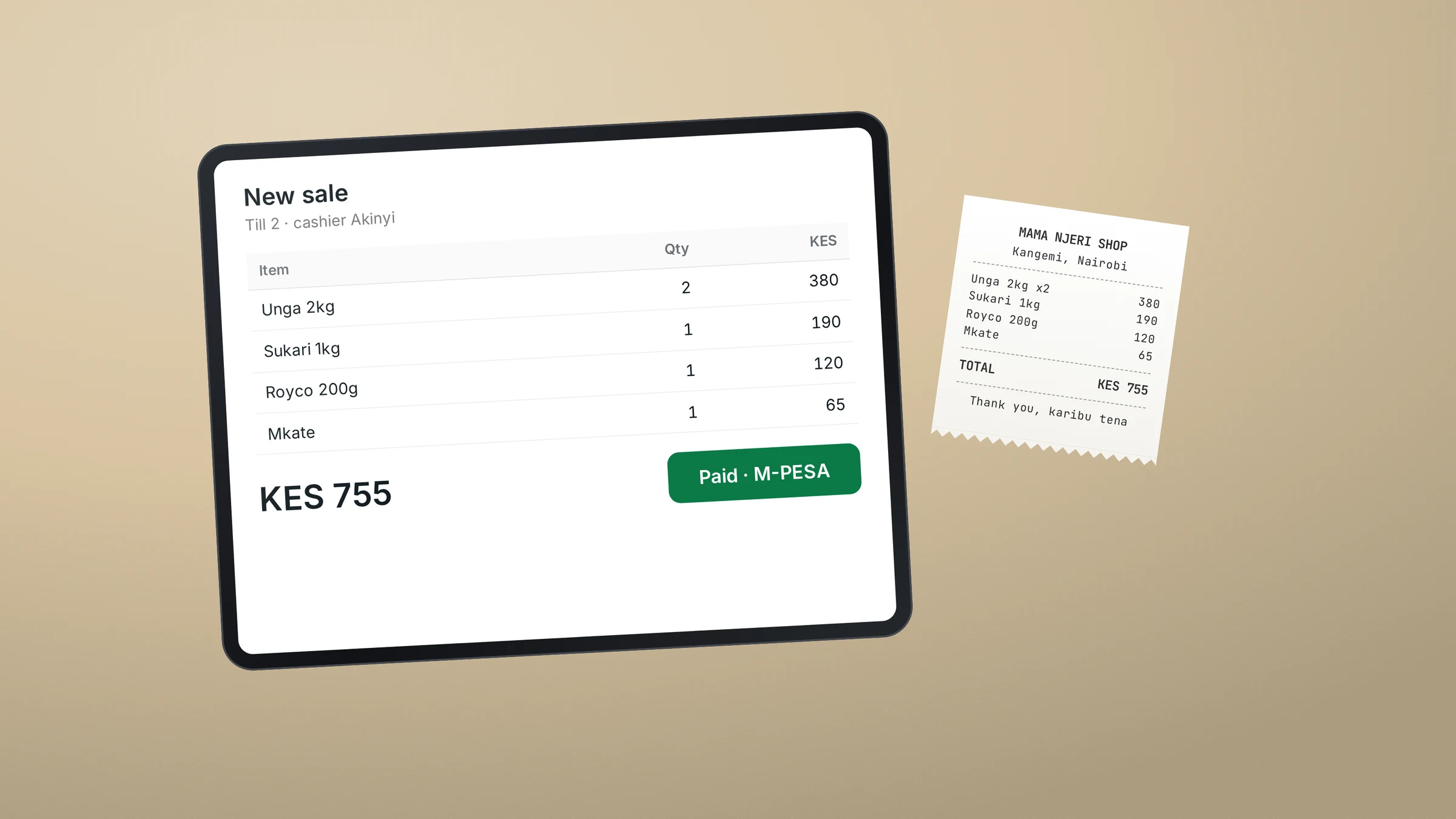
Should have taken is the day's sales, from your sales book or till receipts.
Actually have is split by how customers paid:
- Cash in the drawer, minus the float you started with.
- M-PESA received to your till or paybill today.
- Card payments from the terminal's end-of-day slip.
Add the three. Compare with sales. The difference is your over or short for the day.
That is all it is. The skill is doing it every single day, the same way, and writing down the reason for every difference while someone still remembers.
The ten-minute routine#
Do this at closing, with the attendant who ran the till present.
- Close the sales book. Draw a line under the last sale and total it. No more sales after the line.
- Count the drawer. Count notes and coins by value, write each line down, total it, and take away the morning float (say KES 2,000). Put the float aside for tomorrow.
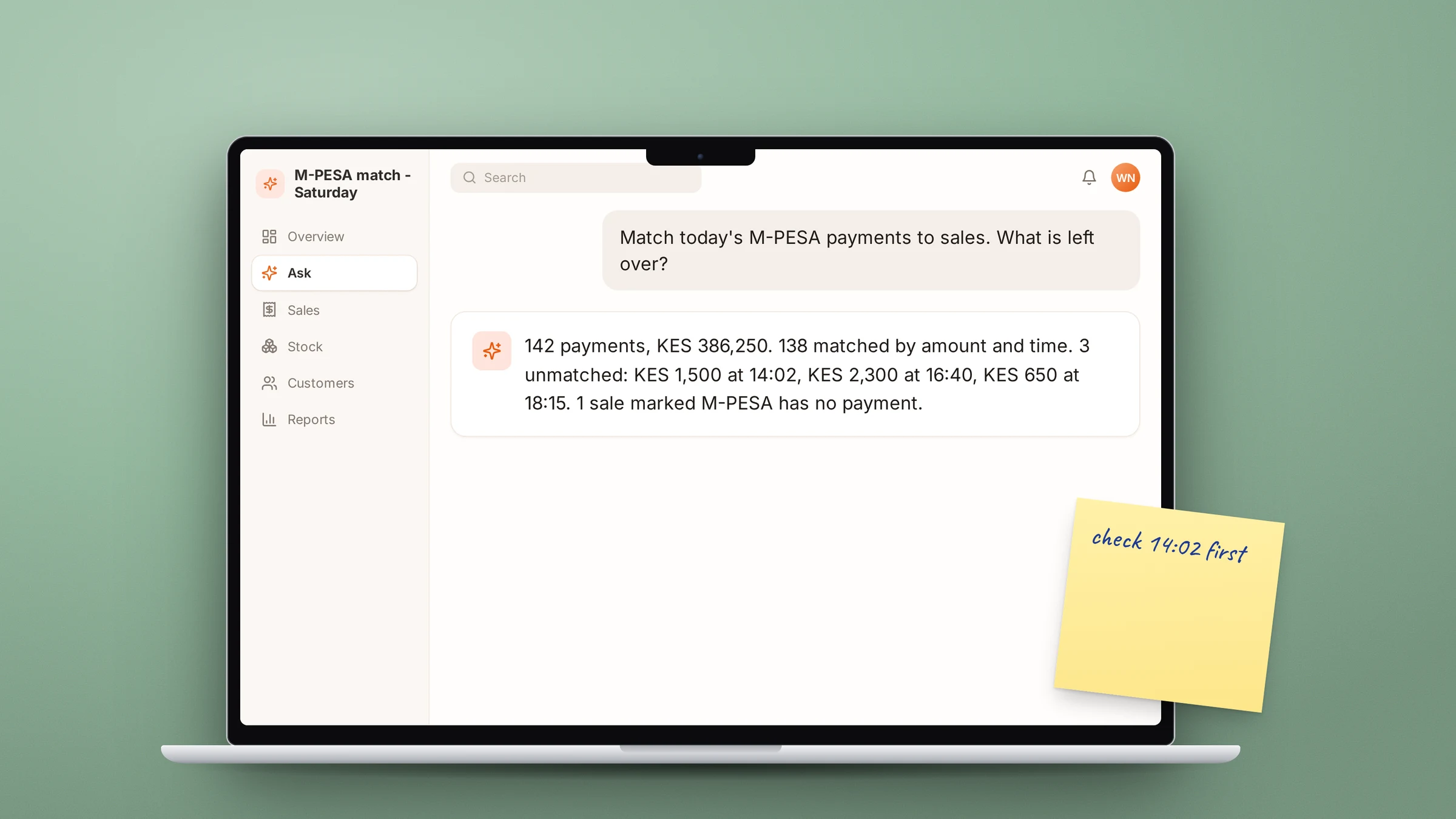
- Check M-PESA. Look at the M-PESA messages or statement for today on the shop line and add up what came in. Check against the M-PESA sales in your book, not the total.
- Print the card slip. Run the terminal's end-of-day total.
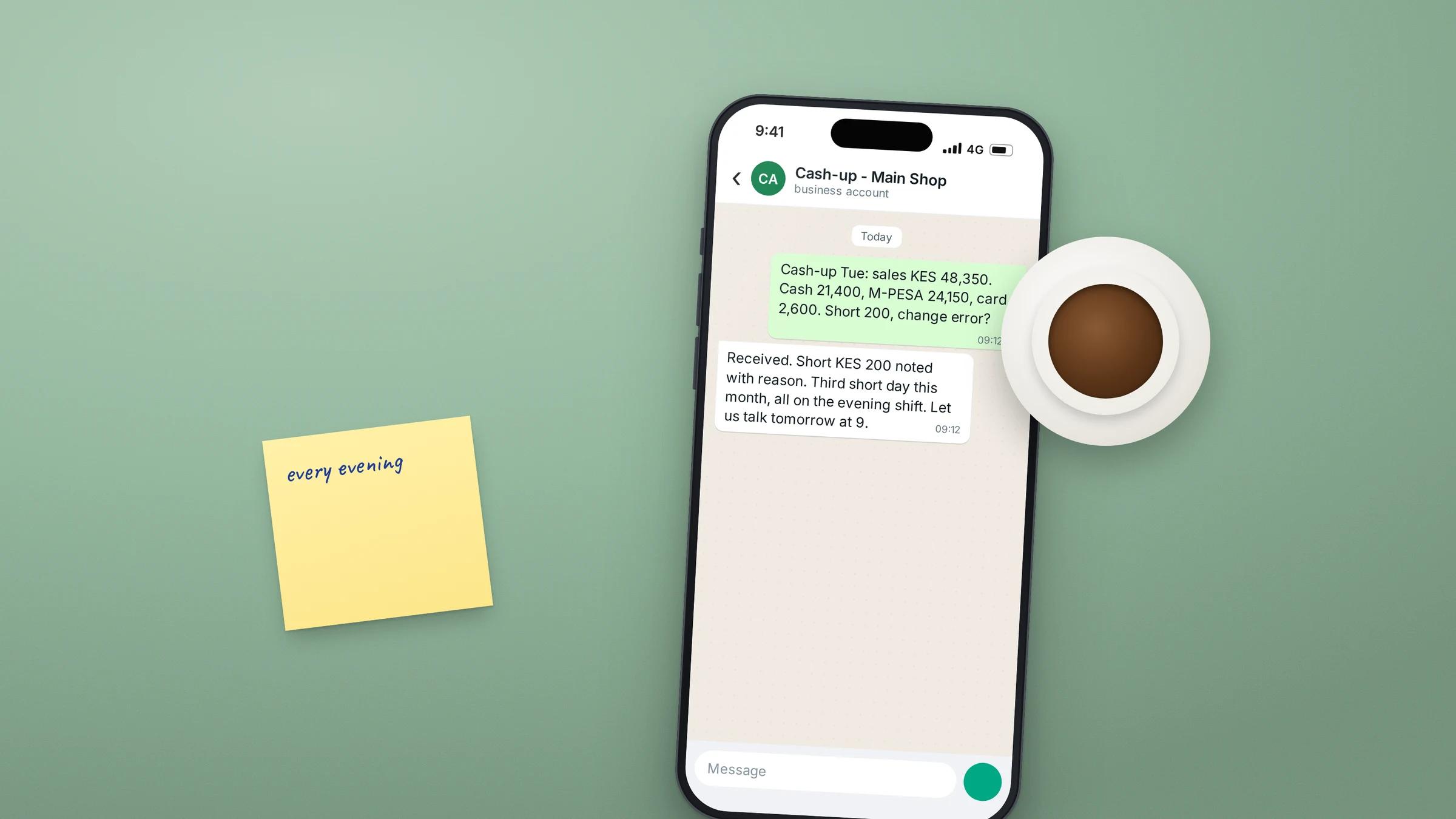
- Write one line. Date, sales total, cash, M-PESA, card, difference, reason, both signatures.
With practice it takes ten minutes. On busy days, fifteen. It is still far less time than an hour of guessing on Sunday night.
If you are not sure what your till or paybill statement does and does not tell you, read till or paybill: what each means for reconciling your shop.
When the numbers do not agree#
They often will not, and that is fine. The point is to know why. The usual causes are dull:
| What you see | Common reason |
|---|---|
| Cash over, M-PESA short by the same amount | A customer paid by M-PESA but it was written as cash |
| Short by a round amount like KES 500 or 1,000 | Change given from the wrong note |
| M-PESA higher than M-PESA sales | A debtor paid an old balance today and it was not written in |
| Short by the price of one item | A sale was not written in the book |
| Over by a small amount | Customer left change, or a price was rounded up |
Write the most likely reason in the line, even if you are not sure. "Possibly change from KES 1,000 note" is useful. A blank is not.
Use the record you are building#
After a month of daily lines you have something valuable: a record of when and where the money goes astray. Look for:
- shorts that cluster on one shift, one day of the week or one person;
- M-PESA sales recorded as cash, which suggests the book is filled in from memory at the end of the day rather than at each sale;
- days with no cash-up at all.
This is also your first real step on the NGAZI ladder. Stage 0 is a business whose numbers live in memory and notebooks. A daily line with five figures is a small, honest dataset. Once it is typed into a simple sheet, or kept by a till system, you can ask questions of it, and later you can ask questions of your M-PESA statement directly.
What to do this week#
Draw up a cash-up sheet with eight columns: date, sales, cash, M-PESA, card, difference, reason, signatures. Start tonight. Do not fix anything for the first week; just record. At the end of the week, read the reasons column out loud with your attendants. You will learn more about your shop in that five minutes than in a month of Sunday nights.