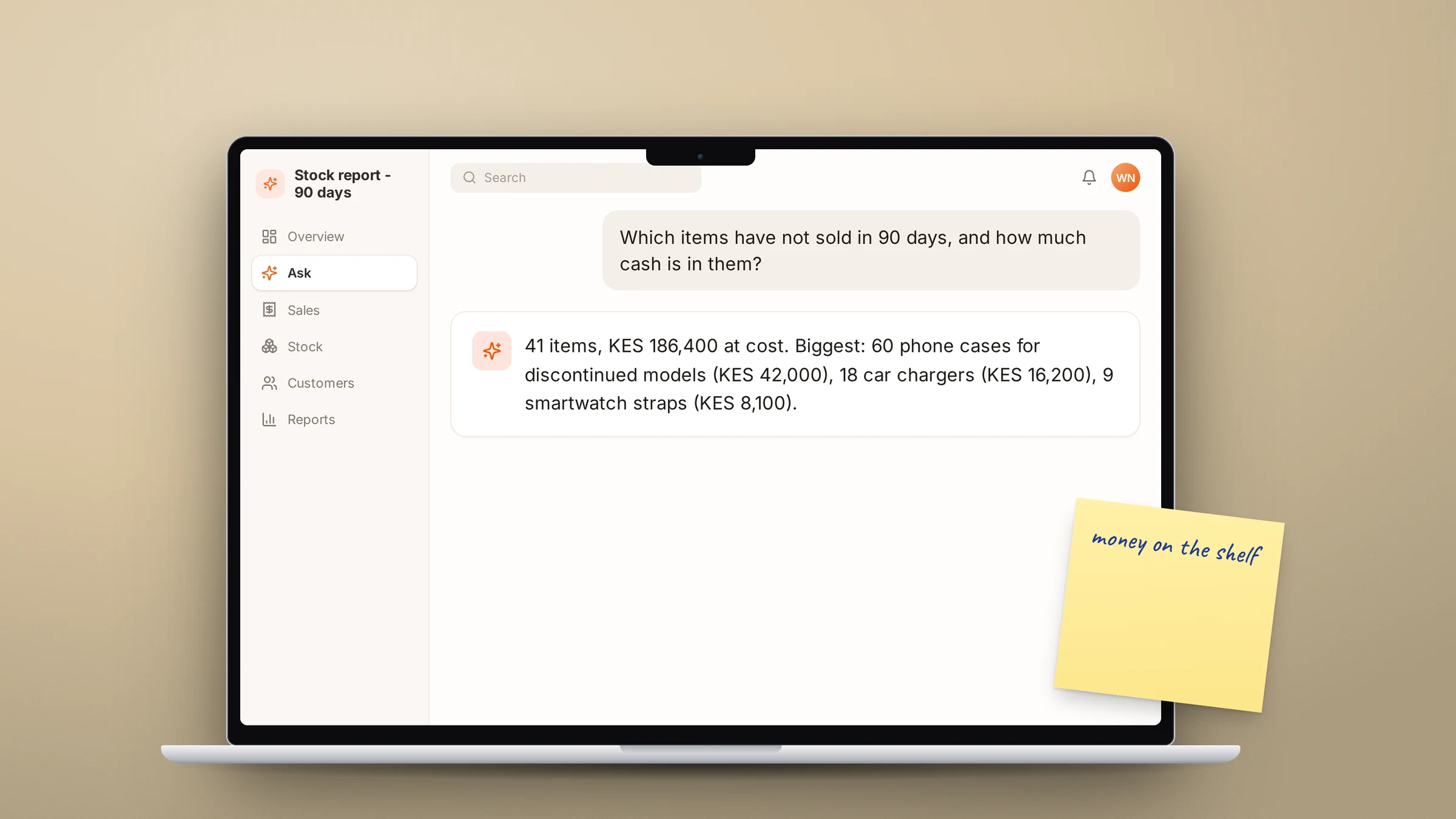
Take Hassan, who runs a phone accessories shop on Moi Avenue (an illustrative example). His shelves are full, his supplier is asking for payment, and he feels short of cash. Both things are true at once, and they are connected. Behind the counter there is a box of 60 phone cases for a model the manufacturer stopped selling last year. He paid KES 700 each for them. That is KES 42,000 he cannot spend on the chargers that sell every day.
Dead stock rarely looks dramatic. It looks like a full shop.
What counts as dead#
A working definition: an item you have in stock that has not sold a single unit in the last 90 days. Some shops use 60, some 120. Seasonal goods such as school items or Christmas decorations need their own rule. Pick a number and use it consistently.
Then put a value on it: quantity on hand times what you paid per unit. Not the selling price. The selling price is what you hope to get; the cost is the cash already gone.
Finding it from your own records#
If your sales go through a till or a system, the answer is already in your records. You need two exports:
- Stock on hand: item, quantity, cost per unit.
- Sales for the last 90 days: item and quantity sold.
This is a Stage 2 job on the NGAZI ladder: an AI assistant working on your own files rather than general knowledge. Upload both files to an assistant that accepts spreadsheets and ask:
Using these two files, list every item with stock on hand and zero sales in the sales file. For each, show quantity, cost per unit and total cost. Sort by total cost, largest first. Then give me the total.
Check the first three rows by hand against your system. If they are right, the list is probably right. If anything looks odd, ask the assistant which rows it used. This is the habit that stops confidently wrong numbers.
Five things to do with each item#
Go down the list, largest value first, and give each item one of these:
Return or swap. Some suppliers will take unsold goods back or swap them for faster lines, especially if you are a regular buyer. Ask before you discount. The worst they can say is no.
Bundle. Put a slow item with a fast one. A car charger with every new phone sold, at a small add-on price, moves chargers without cutting their price on the shelf.
Move. An item that does not sell at the back of the shop may sell at the till. If you have two branches, it may sell at the other one.
Discount. Clear it at a price that recovers some cash. A price that gets back half the cost today is often better than full price in a year that never comes. Be honest with yourself: the goal is cash, not saving face on the original price.
Write off. Damaged, expired or obsolete stock that will never sell should come off the books so it stops distorting your numbers. Speak to your accountant about how to record it.
In Hassan's case, say the phone cases go back to the supplier as a swap for screen protectors, at a small loss on the exchange, and the chargers go into a bundle. That frees more than KES 50,000 without a single "sale" sign.
Stop the next batch#
Dead stock is mostly created at the moment of buying. A supplier offers a good price on a bigger quantity, or a new model looks promising, and nobody checks how the last similar item sold.
Before each order, ask one question: how many of this, or the closest thing to it, did we sell in the last 90 days? If the answer is "none" or "a few", order less or not at all. Reorder points do the opposite job for fast movers, and we covered those in reorder points without a spreadsheet.
What to do this week#
Export your stock and your last 90 days of sales. Produce the dead stock list, check three rows, and add up the total at cost. Then take the five largest items and decide, for each one, return, bundle, move, discount or write off. Act on those five before the end of the week.
The total at the bottom of that list is usually the most persuasive number an owner sees all year.