This is an illustrative walk-through, not a real customer's story. The names, the shop and the figures are invented, to show how an order taken in conversation works with Wavu.
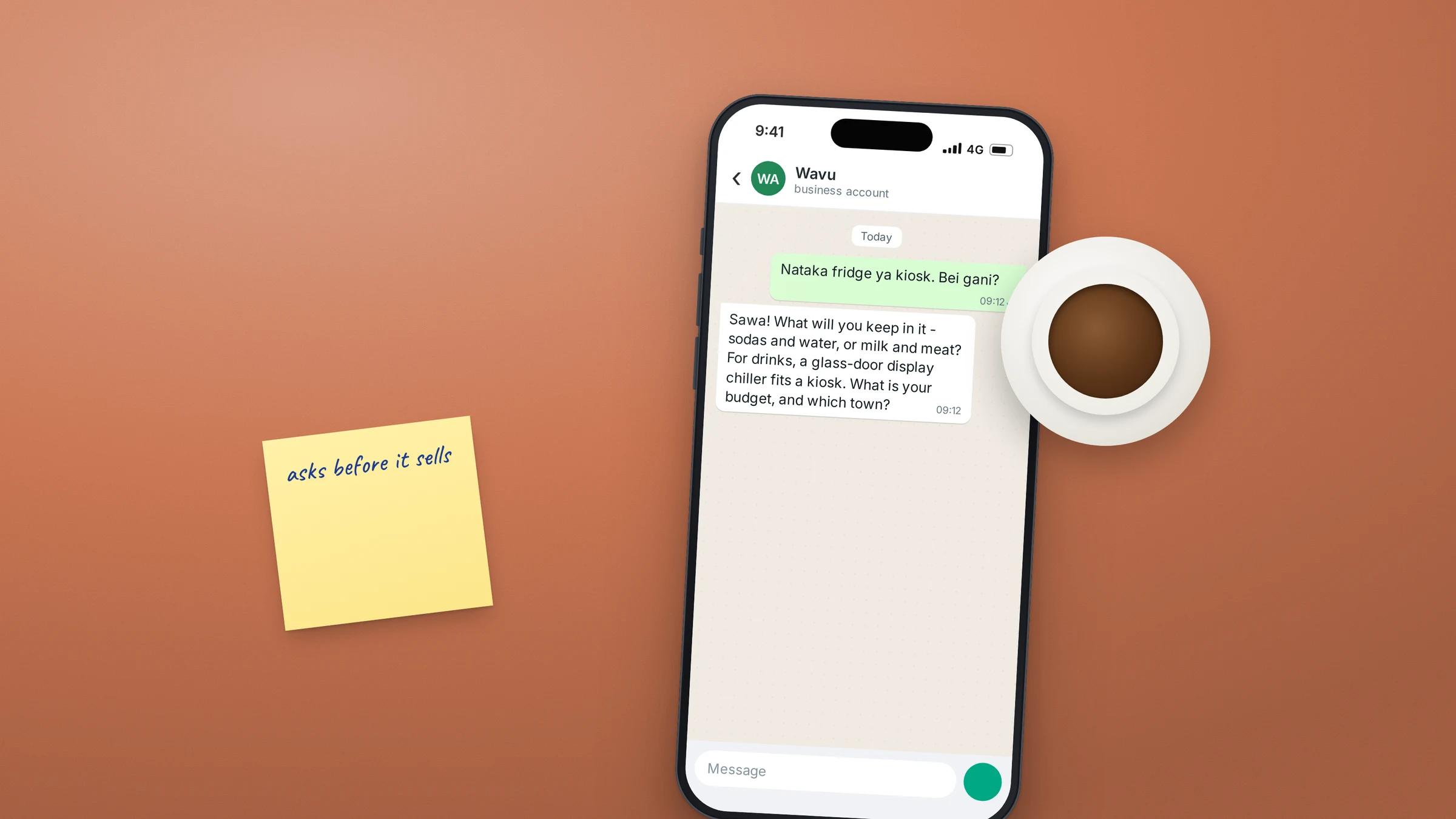
Mama Halima runs a kiosk in Kitale. On a Sunday evening she sends one line to a number she saw on a poster: "Nataka fridge ya kiosk. Bei gani?" I want a fridge for my kiosk, how much?
A typical online shop would answer that with a catalogue: forty fridges, sorted by price, good luck. A typical WhatsApp seller would answer with one price for whatever fridge they happen to have. Neither is what she needs, because she has not yet said what she needs. She has said what she thinks it is called.
What the customer said, and what she meant#
Wavu's job is to have the conversation a good shop assistant would have. So instead of a price list, it asks:
Sawa! What will you keep in it - sodas and water, or milk and meat?
Halima: "Soda na maji. Na yoghurt kidogo."
That one answer changes everything. She does not need a household fridge; she needs a display chiller with a glass door, so customers can see the drinks. Wavu asks two more things:
About how many crates do you sell in a day? And is your power steady, or does it go off often?
She sells about four crates a day, and the power in her area drops in the evenings. Now the request is specific: a mid-sized single-door display chiller, ideally one that copes well with power cuts, for a kiosk in Kitale, at a budget she gives as "around KES 45,000".
The question "what will you keep in it?" is worth more than a catalogue of forty fridges.
Connecting her to the right shop#
With the need clear, Wavu connects Halima to a shop that can meet it: one that stocks display chillers in her budget and can deliver to Kitale. The shop gets an order that already says what she needs, why, where and for how much, instead of "fridge bei gani?"
For the shop, the difference is time. The conversation that usually takes three messages back and forth, a phone call and a misunderstanding has already happened. The salesperson starts at the useful part: confirming the model, the delivery day and payment.
For Halima, the difference is being understood. She asked in Swahili on a Sunday evening and got sensible questions in Swahili, not a link.
Where a person takes over#
This is Stage 3 on the NGAZI ladder: AI acting inside the selling process, within limits. Those limits matter as much as the conversation. A person takes over when:
- The customer wants to negotiate the price or ask for credit.
- The question needs knowledge the shop has not recorded, such as a specific warranty term or a delivery to a place the shop has not served.
- Anything goes wrong: a complaint, a late delivery, a damaged item.
- The customer asks for a person. Always.
The assistant's answers are only as good as the shop's information. If the shop's stock or prices are out of date, the conversation will promise things that are not true. Keeping that information current is the shop's side of the deal.
What a business learns from conversations#
Taking orders in conversation produces something a catalogue does not: a record of what customers asked for in their own words. Over a few months, a shop learns that people asking for "a fridge" mostly mean display chillers, that "solar" questions spike before the long rains, or that many enquiries come from towns it does not deliver to yet. That is useful when deciding what to stock.
What to do this week#
Take the three products customers most often ask about by name. For each, write the three or four questions a good salesperson asks before quoting: what is it for, how big, what budget, where. Share them with whoever answers your WhatsApp, and ask them to use the questions before sending any price for two weeks.
Then compare: how many of those conversations became orders, against the two weeks before? For a related story in a shop setting, see our retail WhatsApp assistant case study.