This is an illustrative example, not a real client. Imagine an agency in Nairobi - call it Baraka Lettings - that manages 212 units for 18 landlords across Kasarani, Ruaka and South B. There are four staff: Wanjiku, who runs the office; Kevin, who handles payments; a caretaker per block; and the owner, Peter, who deals with landlords.
Before they moved onto one system, month-end took about ten days and three spreadsheets. What follows is the same month-end once each step has a home. The point is not the software. It is the order of the steps and who owns each one.
Day 25 to 30: get the list right before anything goes out#
The most common month-end mistake happens before the 1st: an invoice goes to a tenant who moved out, or a new tenant gets nothing. So the last week of the month is for checking the list.
Wanjiku runs through three things:
- Moves: every tenant moving out this month is marked, with the final bill and deposit handled separately. Every new tenant has a lease, a unit and a rent amount in the system.
- Changes: any rent increase starting next month is entered now, with the effective date, so it is not typed in on the 1st.
- Extras: water readings, service charges and parking fees that go on next month's invoice are in.
This takes about two hours. Skipping it costs a week of corrections.
Day 1: invoices go out on their own#
On the 1st, the system creates one invoice per tenant: rent, plus any water, service charge or extras, with the paybill number and the account reference the tenant should use. Each tenant gets theirs by SMS or WhatsApp. Nobody in the office types an invoice.
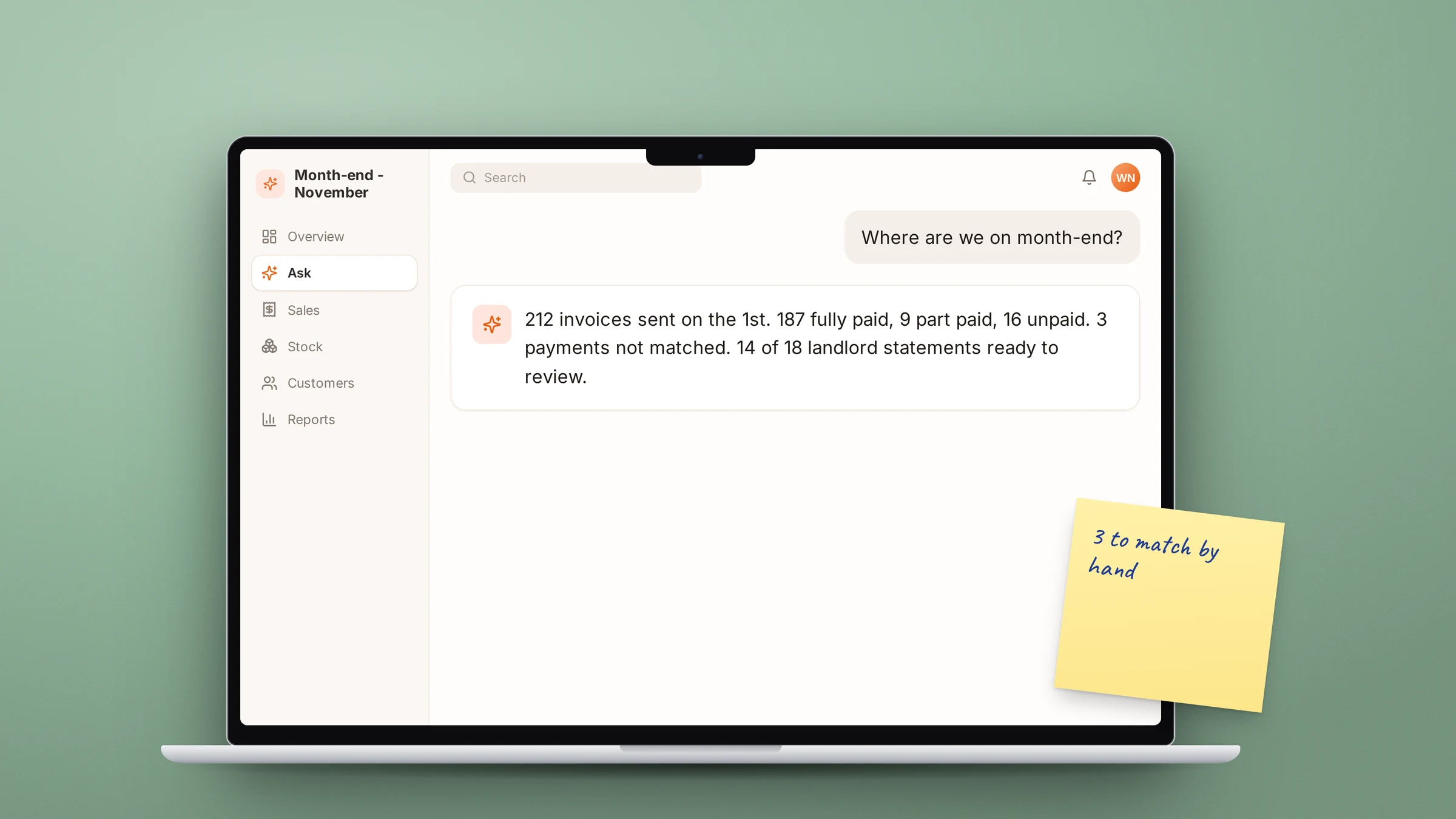
What Wanjiku does on the 1st is read a short report: invoices created, invoices that failed to send (wrong number, usually), and any unit with no invoice that should have one. In our illustrative month that is 212 created, 2 failed to send, 0 missing. She fixes the two numbers and resends.
Day 1 to 10: payments match as they land#
Tenants pay on M-PESA using their account reference. Each payment arrives from the paybill and is matched to the tenant's invoice by that reference. The balance updates, the tenant gets a receipt, and the payment is recorded with its M-PESA code.
Kevin's job changes from matching every payment to handling the exceptions:
- Wrong reference: a tenant typed "rent" instead of their unit number. The payment sits in an unmatched list with the payer's phone number. Kevin looks the number up and assigns it.
- Part payment: the invoice stays open with the balance showing. That is the system working, not a problem to fix.
- Overpayment: the extra sits as a credit on the tenant's account for next month.
In our example, by the 10th: 187 fully paid, 9 part paid, 16 unpaid, and 3 payments that needed Kevin's hands. Three, instead of two hundred.
Day 5 to 10: arrears, kindly and on time#
Reminders go out on their own to anyone unpaid on the 5th, with the balance and the paybill details. On the 8th, Wanjiku gets a list of everyone still unpaid, sorted by amount and by how many months they have been behind. Those are phone calls, and they stay phone calls: a tenant who lost a job needs a person, not a third automatic message. Our monthly arrears routine goes into the detail.
Day 10: landlord statements#
Each of the 18 landlords gets a statement for their units: rent invoiced, rent collected, arrears by unit, expenses paid on their behalf (a plumber, a repaint), the agency's commission, and the amount being sent to them.
Because the invoices, payments and expenses were all recorded against units through the month, the statement is built from those records rather than assembled by hand. Peter's job is to read each one before it goes out. He looks for anything a landlord will ask about: a large repair, a unit empty for a second month, a tenant three months behind. He adds a one-line note on each, and sends.
Landlords care about a few things above all; we covered them in what owners want to see each month.
The system makes the statements. A person reads them before a landlord does.
What changed, and what did not#
In this illustrative month, the agency's month-end shrinks from ten days of three people to a few focused hours spread over the same ten days. What did not change: the checks on the 25th, the calls on the 8th, and Peter reading every statement. Those are the parts that need judgement, and they now get the attention that used to go on typing and matching.
This is Stage 3 on the NGAZI ladder: software doing the routine inside the workflow, people deciding the exceptions. It only works because every tenant, unit, lease and payment is recorded in one place.
What to do this week#
Write your own month-end as a list of dated steps, with one name next to each. Then mark which steps are typing or matching, and which are judgement. The typing and matching ones are where a system pays for itself first; the judgement ones are where your best person should spend the time saved.