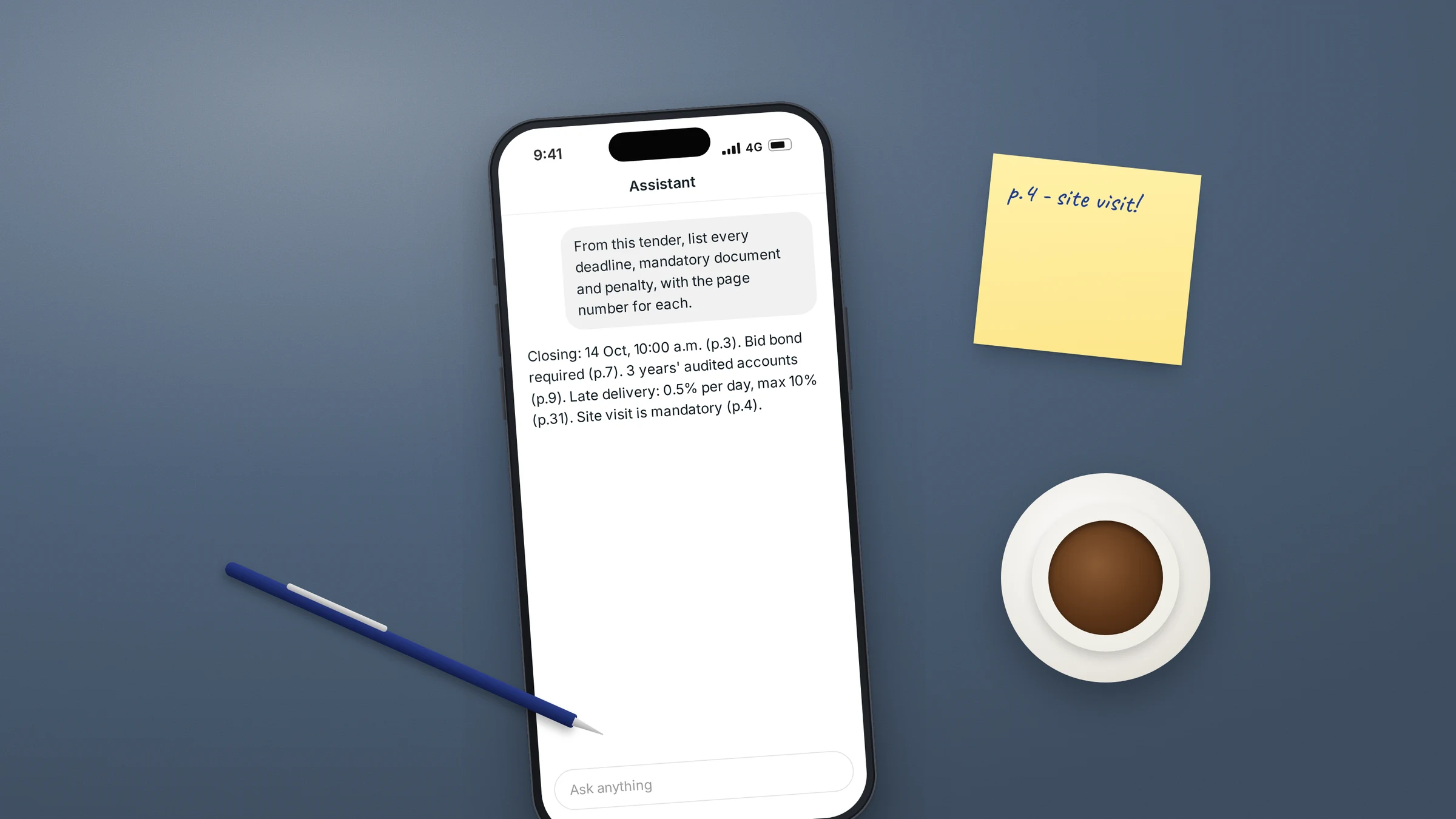
Take Zawadi, who runs a catering company in Nakuru and has just downloaded a tender to supply meals to a boarding school: forty-two pages of instructions, forms, technical specifications and contract terms. She has done tenders before. She knows the price is not usually what loses them. What loses them is a missed requirement on page 4 or a penalty clause on page 31 that turns a good contract into a loss.
She is tempted to paste it into an AI assistant and ask for a summary. That is a reasonable instinct and the wrong question. A summary tells you what the tender is about. You already know what it is about. You need to know what can disqualify you and what can cost you money.
This is Stage 2 on the NGAZI ladder: AI working on your documents. The document is the authority; the assistant is the fast first reader.
Ask for the catches, not a summary#
Give the assistant the full document, ideally as a text-based PDF rather than a phone photo of each page. Then ask specific questions, one group at a time, and always ask for the page number.
Deadlines.
List every date and time in this document: closing date, clarification deadline, site visit, bid validity, delivery start. Give the page number for each.
Eligibility and mandatory documents.
List every requirement a bidder must meet to be considered, and every document that must be submitted. Mark which ones the document calls mandatory. Page numbers for each.
Money and penalties.
List every clause about payment terms, bid security, performance security, penalties, deductions or termination. Quote the key sentence and give the page number.
Specifications that cost money.
List any requirement that would add cost: staff qualifications, equipment, vehicles, certifications, insurance, reporting.
Separate questions get better answers than one big one. And the page numbers matter more than the answers, because they are how you check.
Verify every line on its page#
Now the part that makes this safe. Take the assistant's list and, for each item, open the page it cited and find the sentence. Three things can happen:
- It is there, as stated. Tick it.
- It is there, but different. The penalty is 0.5% per day, not per week. Correct it.
- It is not there. Delete it, and search the document yourself for the topic.
For a forty-page tender this takes perhaps twenty minutes, far less than reading every page from cold, and you finish with a checklist you trust. How to check an AI answer in under a minute has the general habit.
Then do one more pass of your own: read the instructions to bidders, the evaluation criteria and the special conditions of contract in full. Those sections are where disqualifications and penalties hide, and they are short enough to read properly.
Turn the checklist into a bid/no-bid decision#
With a verified list, the decision becomes concrete. For Zawadi, three questions settle it:
- Can we meet every mandatory requirement before the closing date? The mandatory site visit on page 4 is next Tuesday; if nobody can attend, the bid is over before it starts.
- Can we live with the penalties? A 0.5% daily late-delivery deduction on a meals contract means any supply disruption bites quickly.
- Do the costly specifications fit our price? If the tender requires certifications or equipment she does not have, the cost goes into the bid or the bid does not go in.
The assistant can help here too, drafting a one-page bid/no-bid note from the verified checklist. The decision is hers, and anything legal or contractual she is unsure about goes to a lawyer or a procurement adviser, not to the assistant.
Keep what you learn#
Tenders from the same buyer tend to repeat their requirements. Save the verified checklist with the tender. Next time, ask the assistant to compare the new document with the old checklist and list what has changed. That comparison is often the most valuable five minutes of the whole job.
What to do this week#
Take the last tender you bid for, or one you passed on. Run the four groups of questions above, then verify every answer on its cited page. Count how many items were correct, how many needed correcting, and how many the assistant missed that you found yourself. That count tells you how far to trust it on the next one.