Take Njeri, an example wholesaler of cosmetics and hair products near Gikomba. Her rule is simple and she has used it for years: whatever she pays, she adds 30%. She also believes she runs at a 30% margin, and she has planned her rent, two salaries and her own drawings around that. The numbers never quite work. Every few months she borrows from the stock money to cover costs and cannot see why.
The arithmetic is not complicated. It is just that "add 30%" and "30% margin" are two different numbers, and the gap between them is where her missing money goes.
The two numbers, with one item#
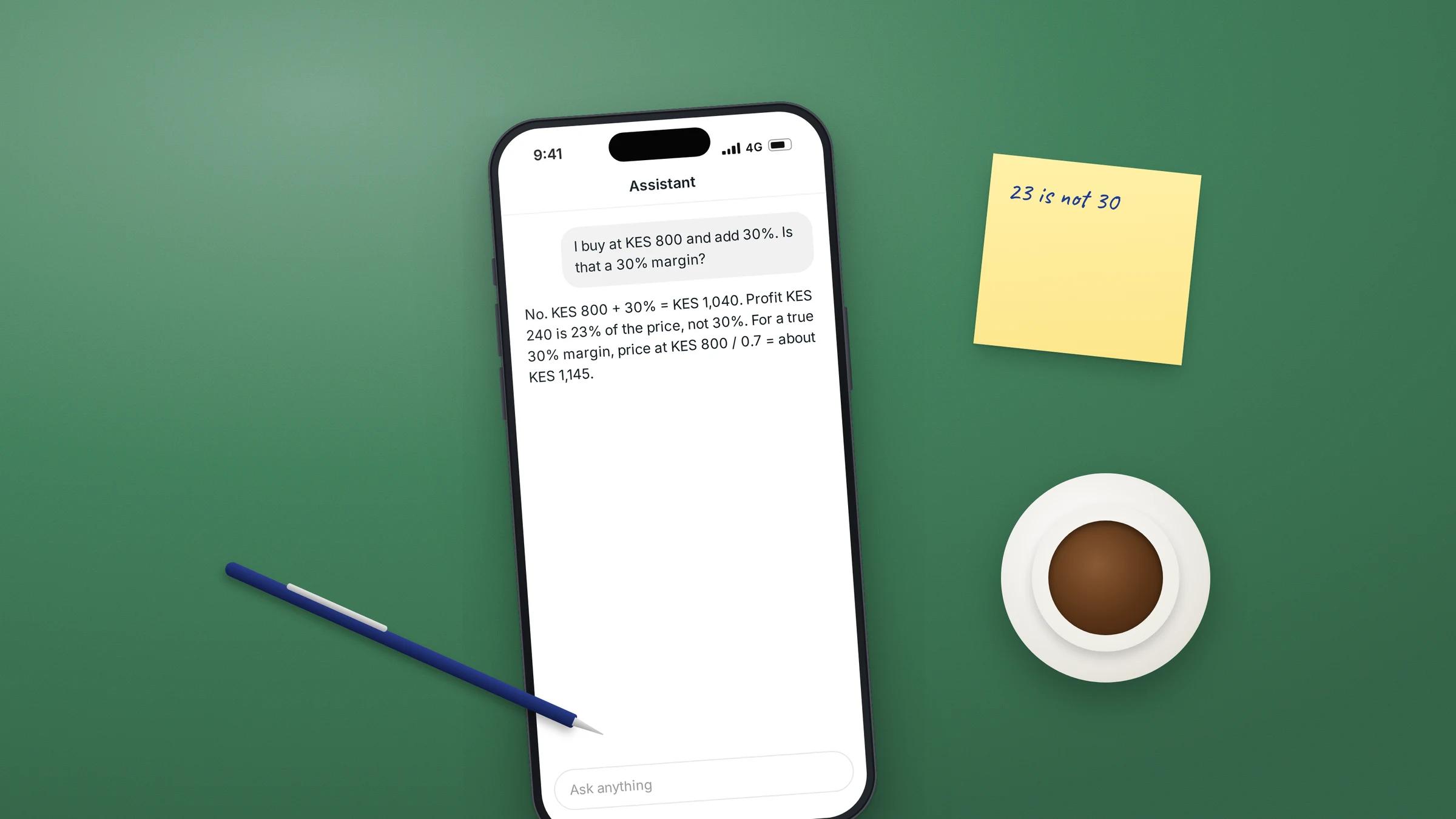
Njeri buys a hair relaxer at KES 800 and sells it at KES 1,040. Her profit on each one is KES 240.
- Markup is profit as a share of what she paid: 240 / 800 = 30%.
- Margin is profit as a share of what the customer paid: 240 / 1,040 = 23%.
Same item, same price, same profit. Two percentages. The markup is always the bigger number, because cost is always smaller than price.
How the gap becomes a loss#
Here is where it bites. Say Njeri sells 500 of these in a month.
- Sales: 500 x KES 1,040 = KES 520,000
- What she thinks her gross profit is (30% of sales): KES 156,000
- What it actually is (500 x KES 240): KES 120,000
She has budgeted KES 140,000 for rent, salaries and her own drawings, expecting about KES 16,000 left over. In reality she is about KES 20,000 short. Every month. Nothing on the shelf looks wrong, the till balances, and the shortfall quietly comes out of the money meant for restocking.
Multiply that across a few hundred product lines and you have a business that feels busy and stays broke.
A shop can balance its till every night and still lose money every month, because the mistake is in the price, not the drawer.
Discounts make it worse#
The same mix-up is dangerous with discounts. An item with a 25% markup, bought at KES 800 and sold at KES 1,000, has a 20% margin. Offer a "20% off" promotion and you sell it at KES 800, exactly what you paid. You have done the work of selling it for nothing.
Before any discount, ask: what is the margin on this item, not the markup? The discount has to be smaller than the margin, with room left for your costs.
Converting between them#
Keep this table near wherever you set prices:
| Markup on cost | Margin on price |
|---|---|
| 20% | 16.7% |
| 25% | 20% |
| 30% | 23.1% |
| 50% | 33.3% |
| 100% | 50% |
And the one formula worth memorising: to get a target margin, divide the cost by (1 minus the margin). For a true 30% margin on a KES 800 item: 800 / 0.70 = KES 1,142.86, so about KES 1,145. Check: profit 345, and 345 / 1,145 is just over 30%.
If you prefer adding to cost, convert your target first. A 30% margin needs a markup of about 43%.
Why this sits at Stage 0#
This article is on the first rung of the NGAZI ladder on purpose. No AI can tell you your margin if nobody recorded what you paid. Plenty of shops record every sale carefully and the cost of nothing, so margin is a feeling rather than a figure. We made the same point in what your shop must record before AI helps: the buying side has to be captured too.
Once cost is recorded against every item, the margin on every sale is just arithmetic, and a system can show you which items carry the business and which ones only look busy. Items that are both low-margin and slow-moving are often the same ones we wrote about in dead stock.
What to do this week#
Take your ten best-selling items. For each, write down what you paid and what you sell it at. Work out the margin: (price minus cost) divided by price. Compare it with the margin you thought you had.
Then take the margin figure, not the markup, and check it against your monthly costs: rent, wages, transport, your own drawings. If the sums only work at the markup figure, you have found the gap. Fix the prices on those ten items first, using the divide-by formula, and see how the next month looks.