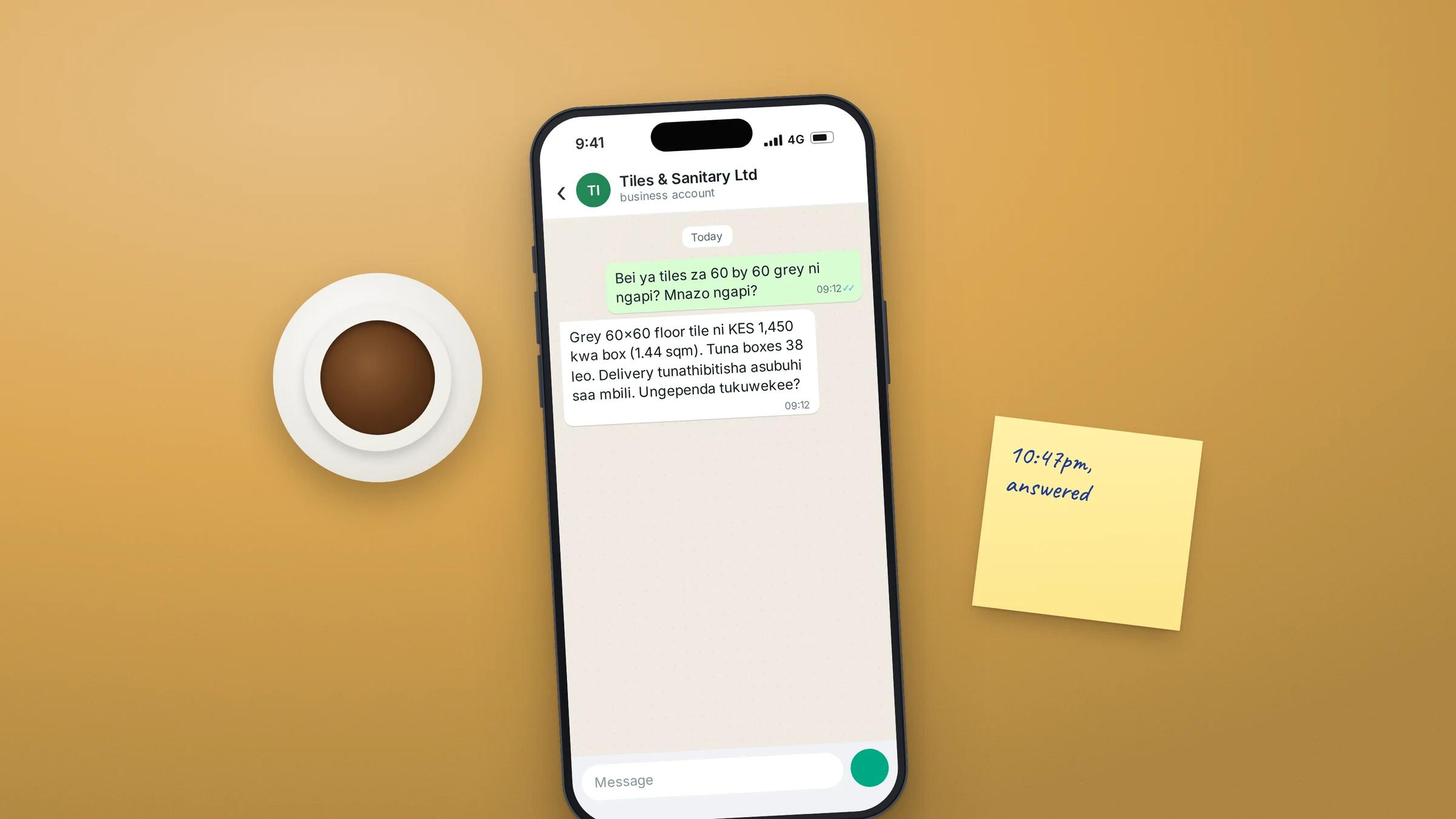
A tile and sanitary ware shop on Mombasa Road closes at 6pm. Its WhatsApp does not. On a typical evening, messages keep arriving until midnight, and the first ones start before 6am: "How much is the grey 60 by 60?" "Do you have the white toilet with the soft-close seat?" "Bei ya cement?" Most are from people standing in an unfinished house with a fundi beside them, ready to buy from whoever answers first.
Take Brian, who owns this illustrative shop. By the time his staff open at 8am and work through the night's questions, half those buyers have already been answered by another shop. The question is simple, the answer is in his system, and nobody is awake to give it.
What "how much?" really asks#
A price question is rarely only about price. Behind "how much is the grey 60 by 60?" there are usually three questions:
- What does it cost? Per box, per square metre, per piece.
- Do you have it? Enough for my floor, today.
- Can I get it? Delivery, collection, how soon.
The first two are facts in your records: your price list and your stock. The third often depends on people: the driver's schedule, the distance, whether a discount applies for a large order. That split decides what an assistant should answer and what it should hand over.
Answer only from the records#
An assistant answering at 10pm must use your actual price list and current stock, never a guess. That sounds obvious. It is also the most common way these setups go wrong: a general chatbot given a PDF price list from three months ago will happily quote last quarter's prices with total confidence.
What it needs:
- One price list, kept up to date in your system, with the unit you sell in (per box, per bag, per metre). We explained why in write your price list once so AI can use it every day.
- Live or recent stock counts. If stock is updated once a day, the assistant should say "we had 38 boxes this evening" rather than promise them.
- Clear item names and common nicknames. Customers say "grey 60 by 60", "sixty sixty", "tiles za grey". Each needs to map to the right item code.
- Rules for what it may say. Listed price only, no discounts, no delivery promises.
This is stage 3 on the NGAZI ladder: AI working inside your workflow, from your real records. Without accurate records, it should not be answering customers at all.
Say "I do not know" well#
The test of a good assistant is what it does when the records do not have the answer. A customer asks for "the tile from your Instagram post last year". The item cannot be matched. A bad assistant guesses. A good one says:
I could not find that exact tile. Could you send a photo? Our team will reply first thing in the morning, from 8am.
And then it makes sure the team actually sees it. "I do not know" is fine. "I do not know" followed by silence is how you lose the customer anyway.
The morning handover#
Every overnight conversation that needs a person goes on one list for the morning, grouped by what is needed:
| Need | Example | Who |
|---|---|---|
| Delivery quote | 40 boxes to Syokimau | Dispatch |
| Bulk discount | 120 boxes for a contractor | Owner |
| Item not matched | Photo of a tile | Sales |
| Reserve stock | "Keep 38 boxes for me" | Sales, confirm by 9am |
Each line includes the customer's question, what the assistant already told them, and the time. Staff start the day with the warmest leads, already qualified. The customer who asked at 10:47pm gets a call at 8:05am, and the price they were quoted is the price they pay.
For the stock side of this, a catalogue that is not in step with your shelves undoes everything; see a WhatsApp catalogue that stays in step with your stock.
What to do this week#
Scroll back through your shop's WhatsApp for the last seven days. Count the messages that arrived outside opening hours and how many were price or stock questions. Then pick five of those questions and check whether your system could have answered each one correctly at that moment: right price, right unit, right stock. If it could, you are ready to automate the answer. If it could not, fix the price list first.