A customer walks up to the counter of a spares shop off Kirinyaga Road holding a worn brake pad wrapped in newspaper. "For a Fielder." The attendant, Brian, has been there three months. He finds a box that looks the same, sells it, and an hour later the customer is back from the mechanic: wrong pad, the 2010 Fielder takes a different one from the 2006. Refund, apology, and a customer who will think twice before coming back.
The shop's owner, Mwangi, would have known instantly. That is the problem. In most spares shops, the knowledge of what fits what lives in one or two senior heads. When they are at lunch, the shop guesses.
Why "for a Fielder" is not enough#
The same model name covers many different vehicles. A Toyota Fielder, a Probox or a Nissan Note can carry different parts depending on the year, the engine, whether it is two- or four-wheel drive, and whether it came through as a Japanese import or a local assembly. Mechanics know this; customers often do not.
The details that actually decide fitment are, roughly in order of usefulness:
- The part number on the old part or its box, when it is readable.
- The chassis or frame code from the logbook or the plate under the bonnet, which narrows the vehicle far more than the model name.
- The engine code (1NZ, 2NZ, QR20 and so on).
- The year of manufacture, which is less reliable on its own because model changes do not follow calendar years.
A shop that asks for these consistently, and records them against each part, stops guessing.
Record each part with its numbers and what it fits#
Every item in the system should carry more than a name and a price. For spares, the useful fields are:
- Your item code, one per distinct part.
- The original manufacturer's part number (OEM number).
- Cross-reference numbers: the aftermarket brands' numbers for the same part. A pad sold under three brands should point at the same OEM number.
- Fitment list: the vehicles it fits, by make, model, chassis code, engine code and years.
- Notes that matter at the counter: "check for ABS sensor", "left side only", "comes without clips".
This is slow to build for your whole stock, so do not try. Start with the 100 parts you sell most, which for many shops are pads, filters, shocks, bushes and bulbs. Add fitment for each as it is sold: whenever a part leaves with a confirmed vehicle, that vehicle goes on its fitment list. Within a few months the list covers most of what walks in.
Selling serialised items like batteries? Their warranty tracking has its own needs; see serial numbers and warranties.
Where AI helps: reading photos and messy questions#
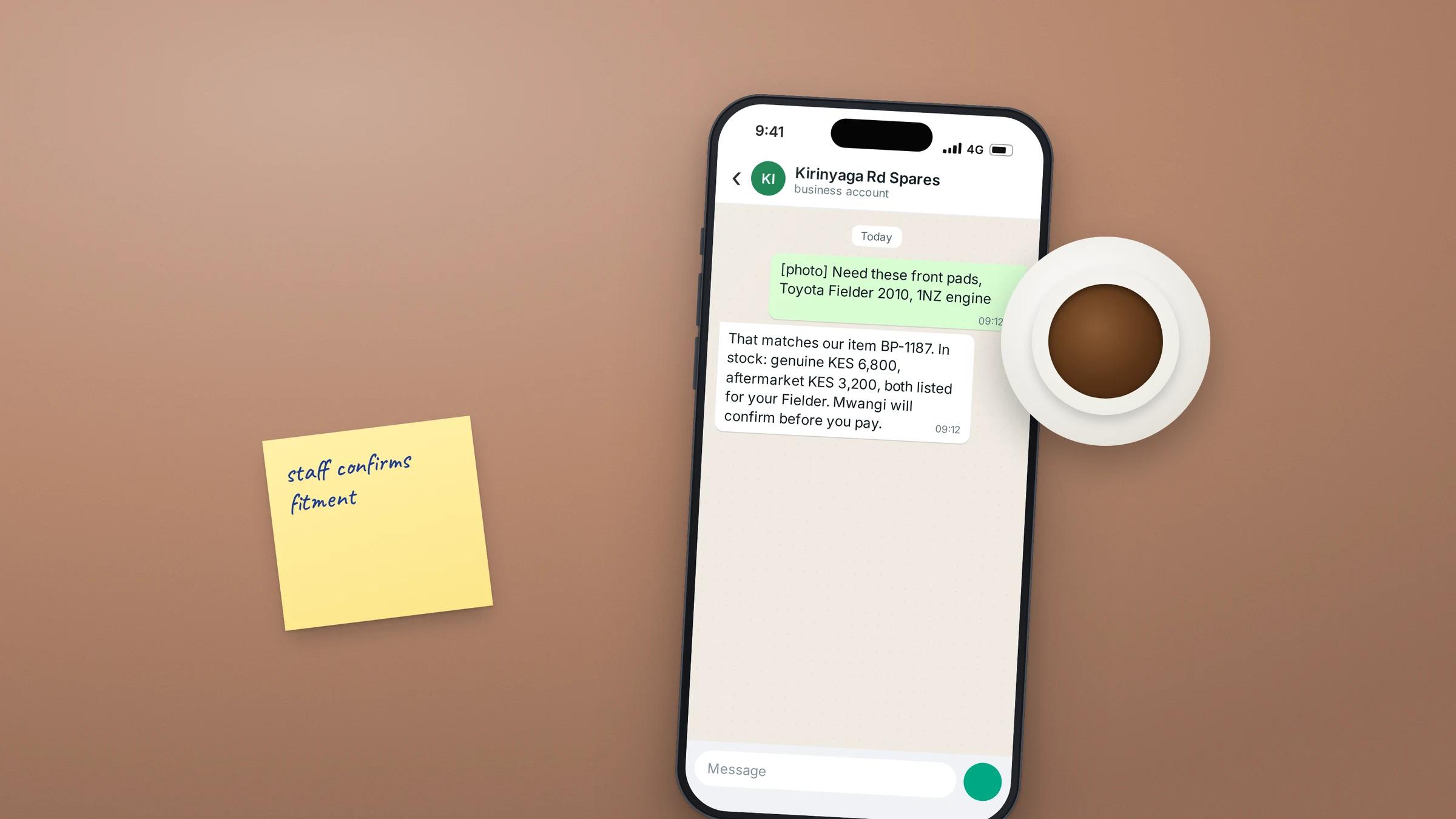
Once part numbers and fitment are recorded, AI becomes useful at the counter and on WhatsApp, because customers rarely ask in neat terms. They send a blurry photo of a part number, a picture of the logbook, or "the rubber thing under the front, makes noise on bumps, Premio 2008".
An assistant can:
- read the number off a photo of the old part or its box and look it up in your item list and cross-references;
- read the chassis and engine code from a logbook photo the customer chooses to send;
- turn a description into a short list of likely parts, with the questions needed to narrow it ("front or rear? left or right?").
It answers from your records, never from general knowledge about cars. If a part is not in your fitment list for that vehicle, the answer is "let me check with the team", not a guess.
This is the pattern we follow everywhere: the AI drafts, people decide. It is the same rule behind no silent writes.
What the records give you later#
Fitment data pays twice. At the counter, it means the newest attendant can answer like the owner. Later, it tells you what to stock: if your records show forty customers asked for parts for one vehicle this quarter and you had the part for twenty-five, you know where you lose sales. Recording "asked for, did not have" alongside sales is the cheapest market research a spares shop can do.
What to do this week#
Take your 20 best-selling parts. For each, find the OEM number and at least one cross-reference, and write down the vehicles you know it fits, with chassis and engine codes. Put a small card at the counter listing the four questions every attendant asks before selling a part: part number, chassis code, engine code, year. Then, from Monday, add the vehicle to the record every time one of those parts is sold.