Picture the front desk of an example outpatient clinic in Nyeri at 11 am. Two receptionists, a queue of six patients, and one phone that keeps ringing. Of the six patients, four are on insurance, across three different insurers. One needs a pre-authorisation for a procedure the doctor has recommended. The receptionist knows each insurer wants something slightly different, but not exactly what. She searches her email for last month's message from that insurer, then calls a colleague, then calls the insurer and waits.
The form takes five minutes. Finding out what the form needs takes forty.
This article is about the administrative side of insurance at a clinic. It says nothing about clinical decisions, which belong to clinicians.
Where the time actually goes#
If you sit at a clinic front desk for a morning and note every insurance-related task, it tends to fall into five buckets:
- Checking cover. Is this member active, which scheme are they on, what does it cover, is there a limit or co-payment?
- Pre-authorisation. For some services the insurer must approve first. Each insurer has its own form, its own required attachments and its own timing.
- Waiting and chasing. Calls and emails to get an approval code while the patient waits.
- Building the claim. Forms, signatures, stamps, invoices, approval codes, attachments, in the format each insurer accepts.
- Handling rejections. Finding out why a claim came back, fixing it, resubmitting, and reconciling payments that arrive weeks later.
Try this yourself for one week: a simple tally of minutes per bucket. In many clinics, buckets 2 and 5 are where the hours hide, and both have the same root: not knowing exactly what this insurer requires.
Why claims come back#
Rejections are rarely about the care. They are about the paper. Common reasons include a missing doctor's signature or stamp, an approval code that was obtained but not written on the claim, member details that do not match the card, a missing attachment, or a claim sent after the insurer's deadline.
Each of these is preventable at the desk, if the person building the claim knows what that insurer checks.
One library of insurer rules#
The first fix is not AI at all. Gather, for every insurer you work with:
- Their current provider guide or scheme rules.
- Their pre-authorisation form and its instructions.
- Their claim form and submission instructions, including deadlines.
- Any circulars or emails that changed the rules.
Put them in one shared folder, one sub-folder per insurer, and name a person responsible for keeping it current. When an insurer emails a change, it goes into the folder that day.
An assistant that reads only those documents#
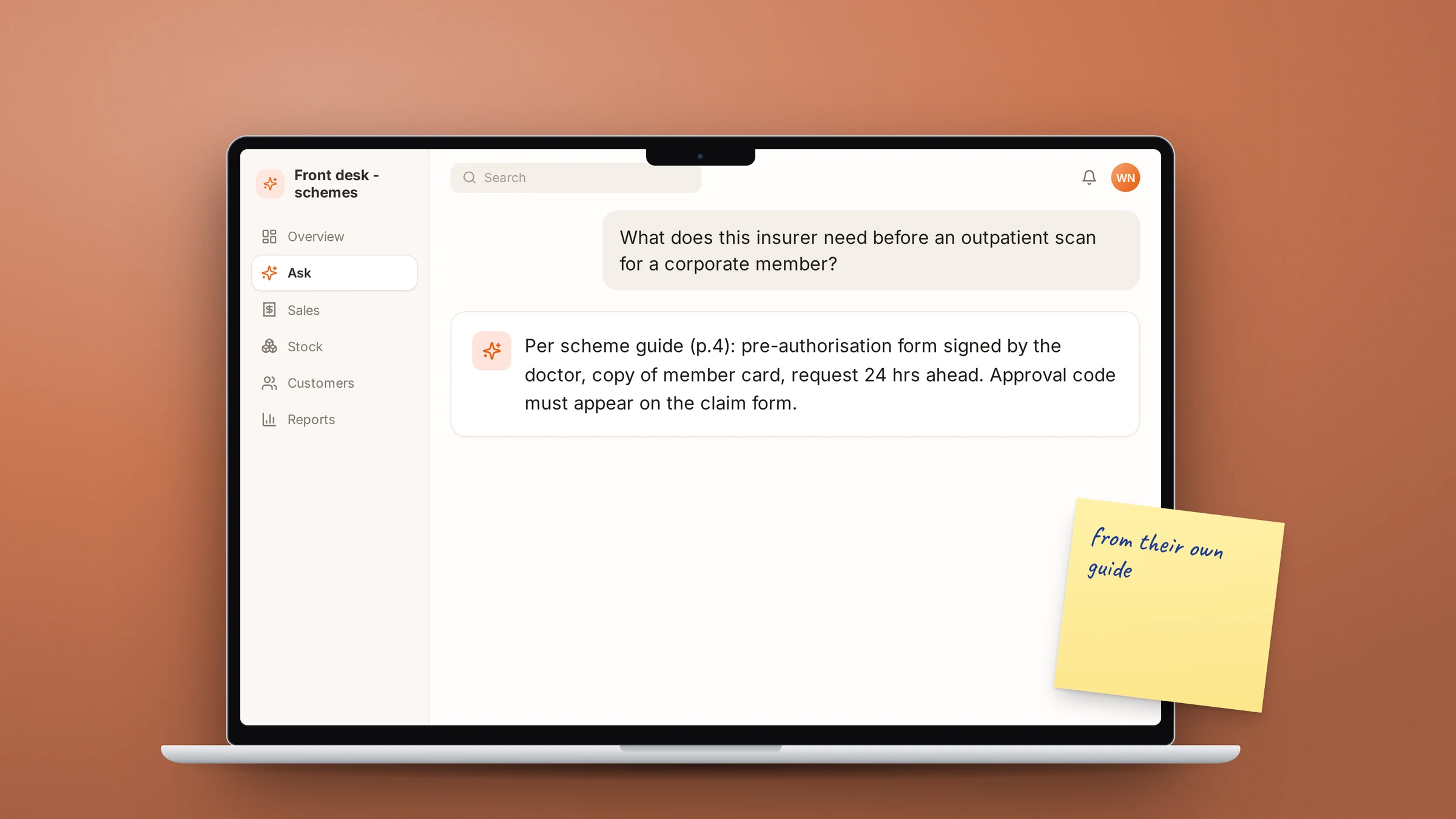
Once the library exists, this becomes a Stage 2 problem on the NGAZI ladder: AI answering from your own documents, not from general knowledge. The technique is retrieval: the assistant finds the relevant passage in the insurer's own guide and answers from it, showing which document and page the answer came from. We explained how that works in RAG on your documents.
At the desk, the receptionist types: "What does this insurer need for pre-authorisation of an outpatient scan?" and gets the requirements, with the page reference, in seconds. If the documents do not say, the assistant should say it does not know, and the receptionist calls the insurer as before.
The same library supports a pre-submission checklist per insurer. Before a claim goes out, the receptionist runs through it: signatures, stamps, approval code, member details matching the card, attachments, within the deadline. That one minute per claim is where rejections are prevented.
What to do this week#
Run the one-week tally across the five buckets. Then pick the insurer that causes the most rejections and build its checklist from its own guide: every item that must be on or attached to a claim. Use it on every claim to that insurer for a month, and compare the rejections with the month before.
For the other end of the patient journey, our piece on appointment reminders that cut no-shows covers the front desk's other daily drain.