Picture a clinic manager in Eldoret doing a month-end count of the supply cupboard. The dispensary's tablets roughly match the records. The consumables do not. The system says there should be eleven boxes of examination gloves; there are four. Nobody stole them. They went to the treatment room, the lab and the maternity side, one box at a time, and nobody wrote it down because "it's just gloves".
At KES 900 a box, seven missing boxes is a small loss. The same pattern across syringes, cannulas, dressings and test kits is not. And because nobody knows where the stock went, nobody can say whether the clinic is ordering too much or using too much.
As with everything we write for clinics, this is about operations: counting, ordering and storing. Clinical decisions, and the rules your regulator sets on handling and dispensing medicines, sit outside it and come first.
How stock leaves a clinic#
A retail pharmacy has one main exit for stock: the counter. A clinic has several:
- Dispensing to patients after a consultation.
- Procedures, where consumables are used in the treatment room: dressings, sutures, gloves, syringes.
- The lab, which uses test kits, tubes and reagents.
- Other departments drawing supplies from the main store.
- Expiry and damage, which must be written off, not quietly removed.
If only the first is recorded, every other exit looks like a loss. The count will never match, and staff stop trusting it.
Link every issue to a visit or a department#
The rule that fixes most of this: every item that leaves the store is linked to a patient visit or to a department. In practice:
Dispensing is linked to the visit automatically if prescriptions are captured in your clinic system.
Procedure consumables are added to the visit too, in standard bundles. A dressing change might be one pair of gloves, one gauze pack, one crepe bandage. Set the bundle up once; the nurse selects "dressing change" and the stock moves.
Department issues go through a simple stock transfer: the lab requests 20 test kits, the store issues them, the lab's stock goes up and the main store's goes down. Each department then becomes a small store of its own that can be counted.
The bundles are the part that takes thought. Ask the nurses, not the office, what a typical procedure actually uses. If the bundles are wrong, the gaps will be wrong too.
Count weekly, a few items at a time#
A full count once a month is a big job and finds problems a month late. A better rhythm is to count ten to fifteen items a week, rotating through the store, with the fast-moving and costly ones every week.
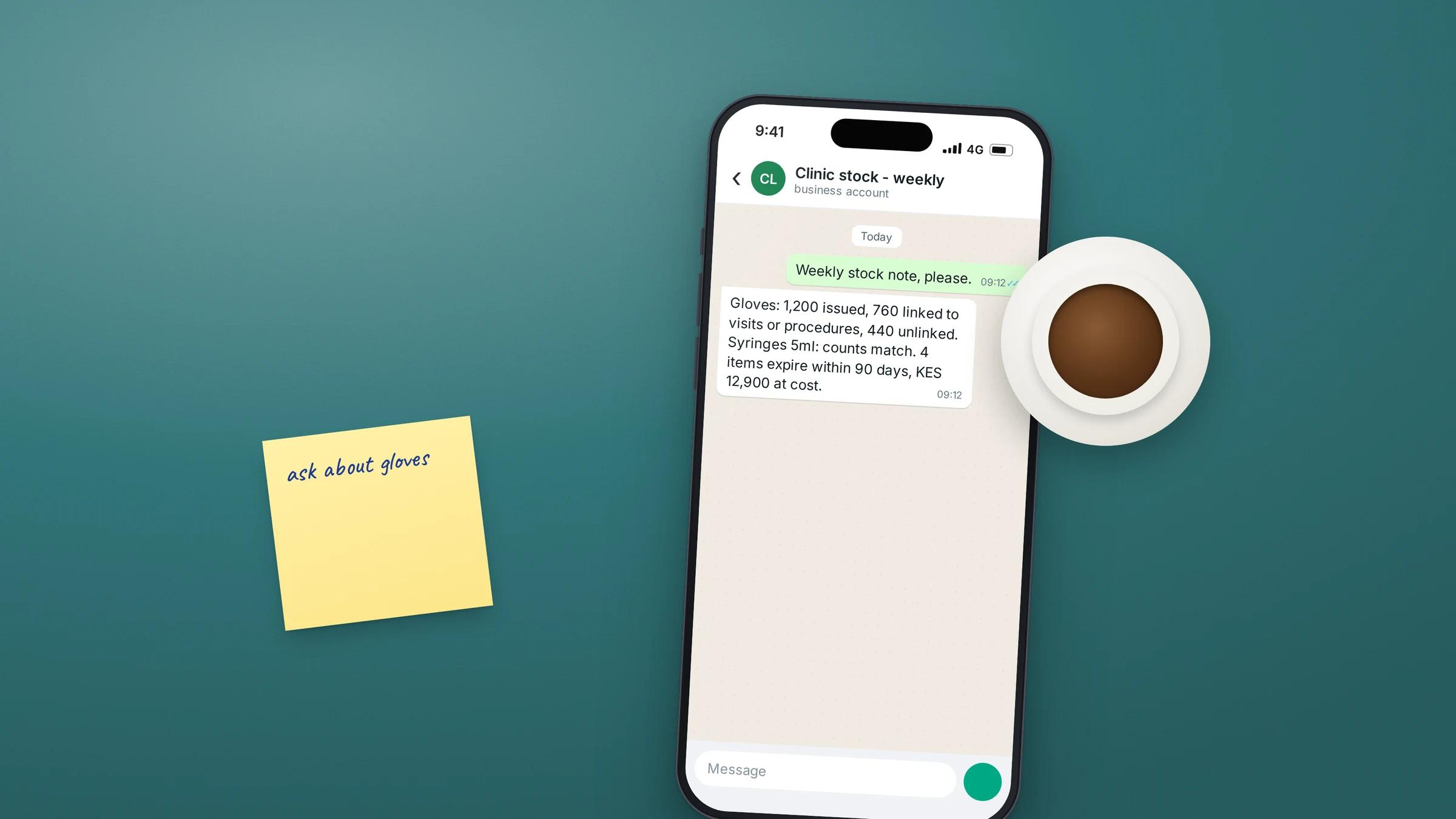
This is where Stage 3 of the NGAZI ladder helps. Each week the system can send the manager a short note: for each counted item, what was issued, what was linked to visits or departments, and the gap. A gap on gloves with nothing else wrong points to an unrecorded procedure or a department drawing without a transfer, a conversation for Monday morning, not an accusation.
Expiry in a clinic: smaller volumes, same discipline#
Clinics often hold small quantities of many items, some used rarely: a particular injection, a paediatric suspension, a test kit for an uncommon request. These are the ones that expire, because nobody sells them down.
The mechanics are the same as for a retail pharmacy, which we covered in expiry dates and stock rotation: record batch and expiry at receiving, store first-expiry-first-out, and get warned months before. Two clinic-specific habits help:
- Order rarely used items in smaller packs, even at a higher unit cost. A write-off of a large pack costs more than the price difference.
- Keep expiry in the department stores too. A lab fridge with its own short-dated kits is easy to forget when only the main store is checked.
What the numbers give you#
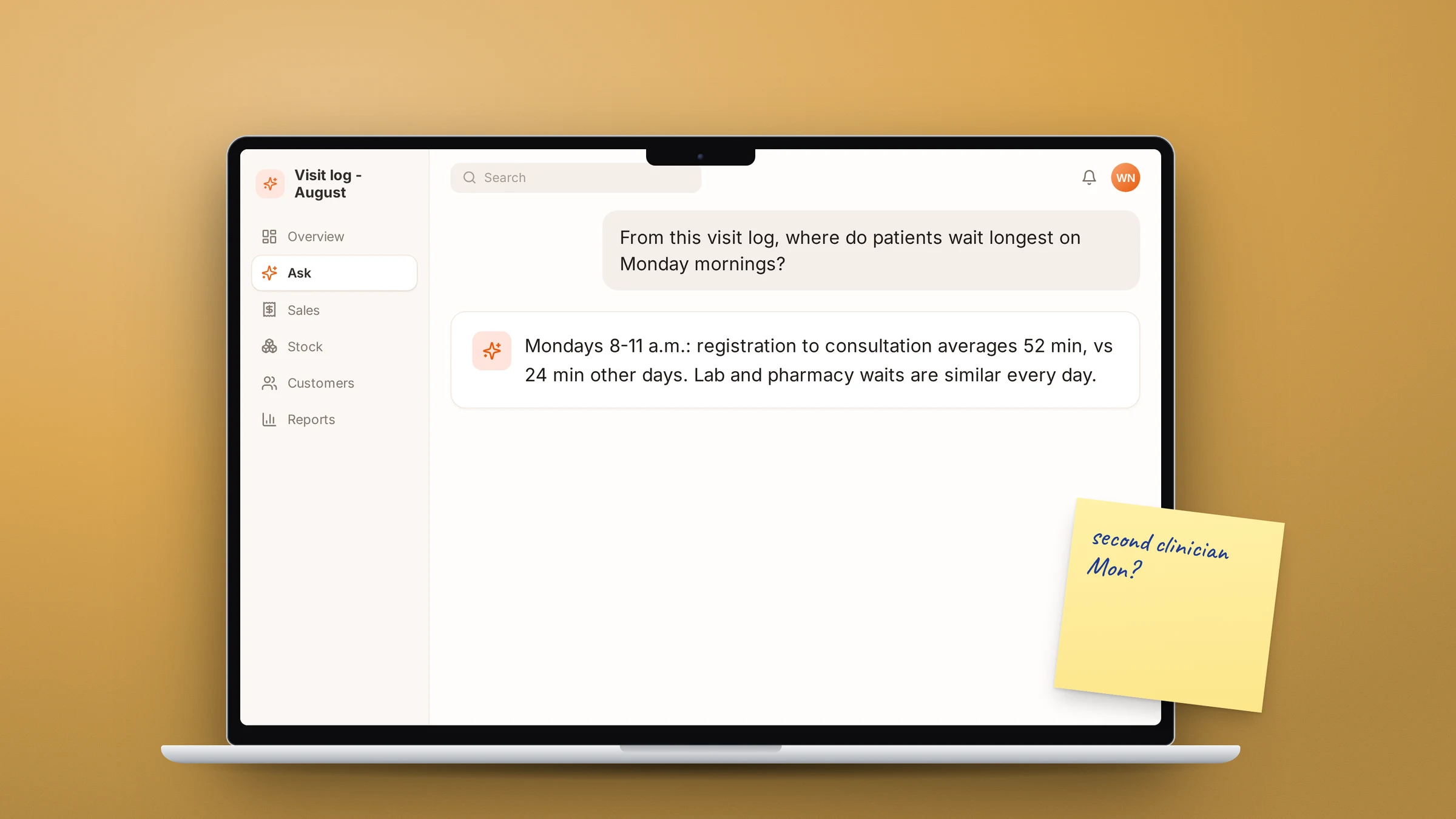
After two or three months, the linked records answer questions that used to be guesses: what a typical dressing change costs in supplies, how many test kits the lab uses per week, which departments draw more than their activity explains. Those figures make ordering simpler and help when you price procedures. They also fit the visit records you may already be using to measure patient queues.
What to do this week#
Pick the five consumables you spend most on. Count them today, and count them again in seven days. In between, ask every department to write down what they take from the store on a sheet by the door. At the end of the week, compare: count difference, sheet total and visits recorded. Wherever the three do not agree, you have found the first bundle or transfer to set up.