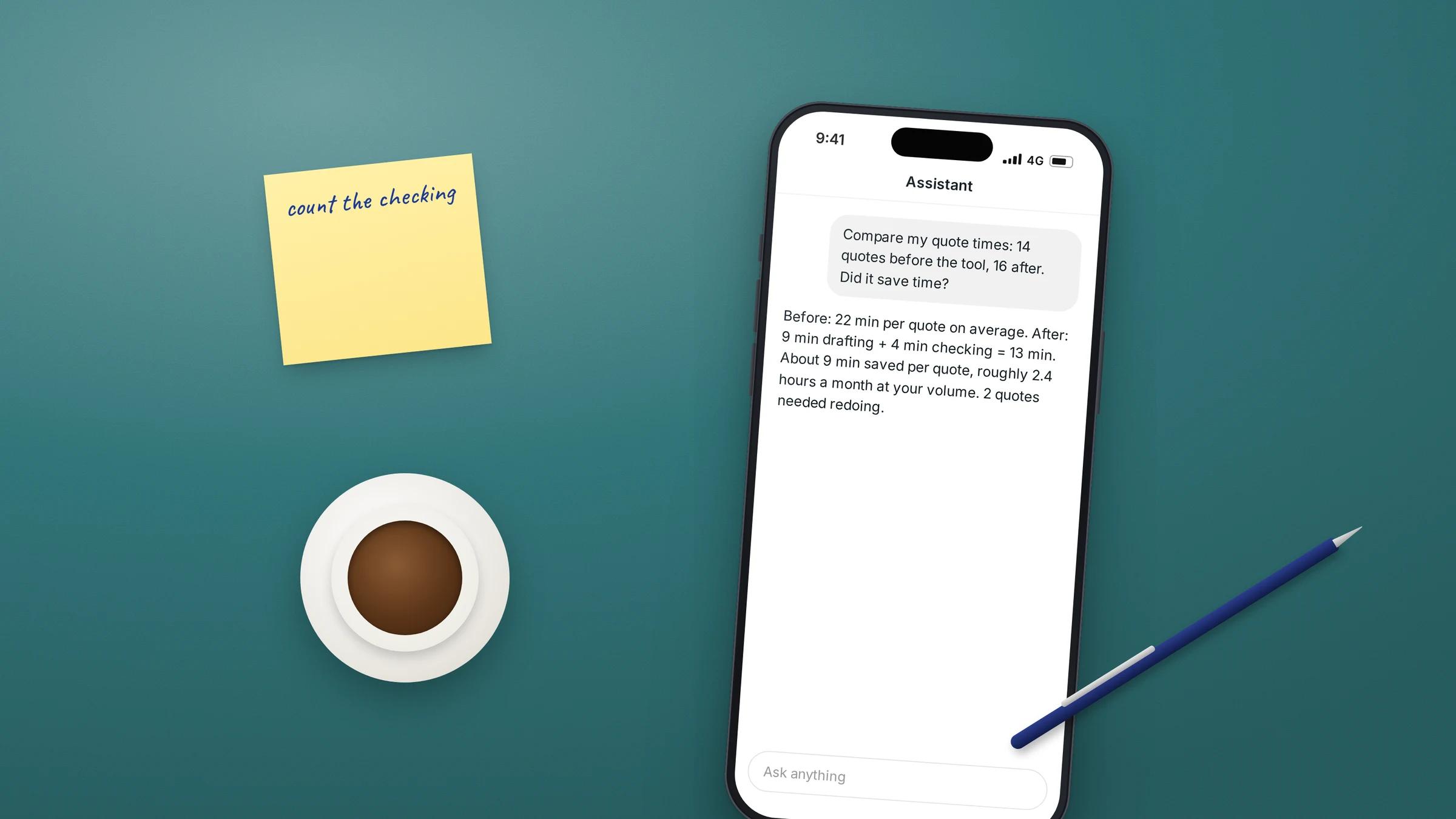
Take Kiprono, who runs a small printing business in Kitale and started using an AI assistant to draft customer quotes three months ago. Ask him whether it saves time and he says "definitely, a lot". Time it properly and it does save time, about nine minutes a quote. But "a lot" includes the quotes that were fast, and forgets the two that had to be redone because the assistant used last year's paper prices.
That is normal. People judge new tools by how they feel, and feelings remember the best moments. If you are paying for an AI tool, or deciding whether to, you deserve a better answer than a feeling. Here is a method that takes a few seconds per task and four weeks of patience.
Pick one task and define it tightly#
Measure one task, not "my work". Choose something you do often enough to get at least ten examples in two weeks: writing a quote, replying to a supplier, preparing a delivery note, summarising a document.
Then write down exactly where the task starts and ends. For Kiprono: it starts when he opens the customer's request and ends when the quote is sent. Everything in between counts, including looking up prices, checking the arithmetic and fixing mistakes.
A tight definition stops you from moving the goalposts later.
Two weeks before: time it as it is#
Before using the tool (or, if you already use it, for two weeks without it), write down for each instance of the task:
- the date;
- the start and end time, or the minutes taken;
- anything unusual ("big order, many items", "interrupted by a customer").
A notebook works. So does a note on your phone, or a simple sheet with three columns. Do not try to be faster because you are timing yourself; just work normally.
Two weeks matters because tasks vary. One day's quotes might all be simple. Over two weeks you see a realistic mix.
Two weeks after: time it the same way, including the checking#
Now use the AI tool for the same task, for two weeks, and time it the same way. The part people forget is the checking. Every AI draft has to be read before it goes out, and sometimes corrected. That time belongs to the task.
Record three extra things:
- drafting time, with the tool;
- checking and fixing time, separately;
- redos: any time the output was wrong enough that the work had to be redone, or caused a problem later, such as a customer querying a wrong price.
Compare, then decide#
At the end of four weeks, work out the average time per task before and after. Then multiply the saving by how many times a month you do the task. For Kiprono, about nine minutes on roughly sixteen quotes a month comes to about two and a half hours.
Then ask three questions:
- Is the saving real? If the difference is a minute or two and your timings vary by ten, you cannot tell. Keep timing for another two weeks, or accept that it is small.
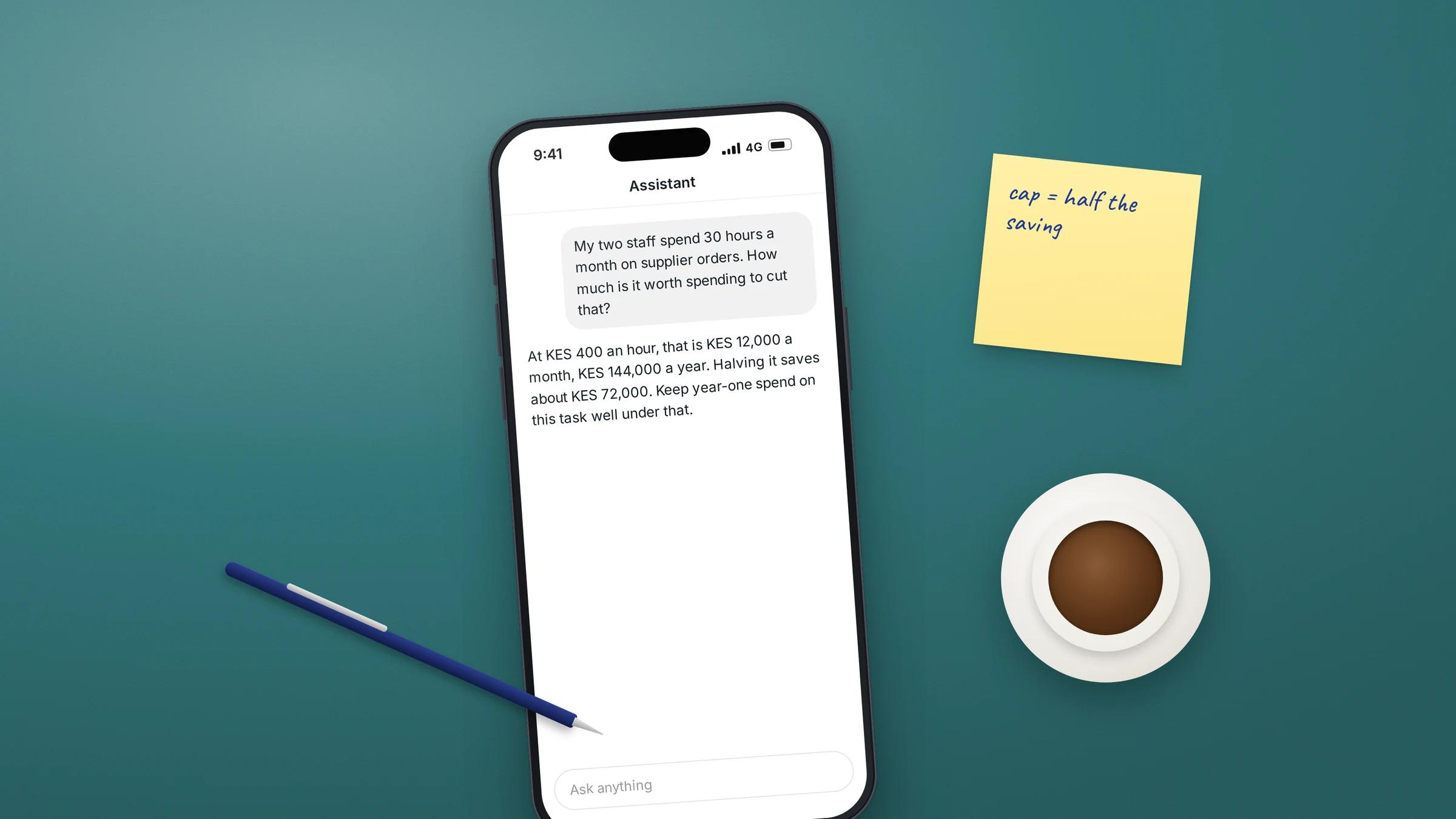
- Is it worth the cost? Put a value on the hours saved and compare it with what the tool costs each month, including any subscription. We covered how to set that limit in how much to spend on AI in year one.
- Did quality change? Faster is not better if customers notice mistakes or the result reads worse. Look at the redos and any complaints.
A tool that saves nine minutes on a task you do twice a month is a toy. On a task you do twenty times a day, it is a member of staff.
Keep the numbers honest#
A few traps to avoid:
- Timing only the good days. Time every instance in the period, not the ones you remember.
- Changing the task. If you started including extra detail in quotes after the tool arrived, note it; you are now comparing different work.
- Forgetting the learning curve. The first few days with any tool are slower. If you can, start the "after" timing in the second week of use.
- Counting someone else's time as free. If the tool saves you time but a staff member now spends longer fixing its output, count both.
The same method works for any change, not only AI: a new till, a new supplier ordering process, a new staff routine. Once you have done it once, it becomes a habit for every tool you pay for.
What to do this week#
Choose the task you most hope AI will speed up. Write down exactly where it starts and ends. Then time every instance for the next two weeks, as you do it today, in a notebook or a phone note. That baseline is the half of the comparison most people never collect, and without it no one, including the tool's seller, can tell you whether it worked.