At the cashier's window of a clinic in Eldoret, a father is holding a printed bill. His insurance covers the family, so he expected to pay nothing. The bill says "Balance due: KES 1,500". The cashier, Chebet, explains: KES 500 is the co-pay his cover asks for on every visit, and KES 1,000 is for a test his scheme does not include. He has never heard either word used that way. There is a queue behind him. Everyone is now unhappy, and none of it is about whether the bill is correct.
Bills at clinics are confusing because they combine three parties - the clinic, the patient and an insurer - and three vocabularies. Most disputes disappear when the patient understands what they are being asked to pay and why, ideally before they reach the window.
Find the five explanations you give every day#
Ask the cashier and front desk to note, for one week, every billing question they have to explain. Most clinics end up with the same handful:
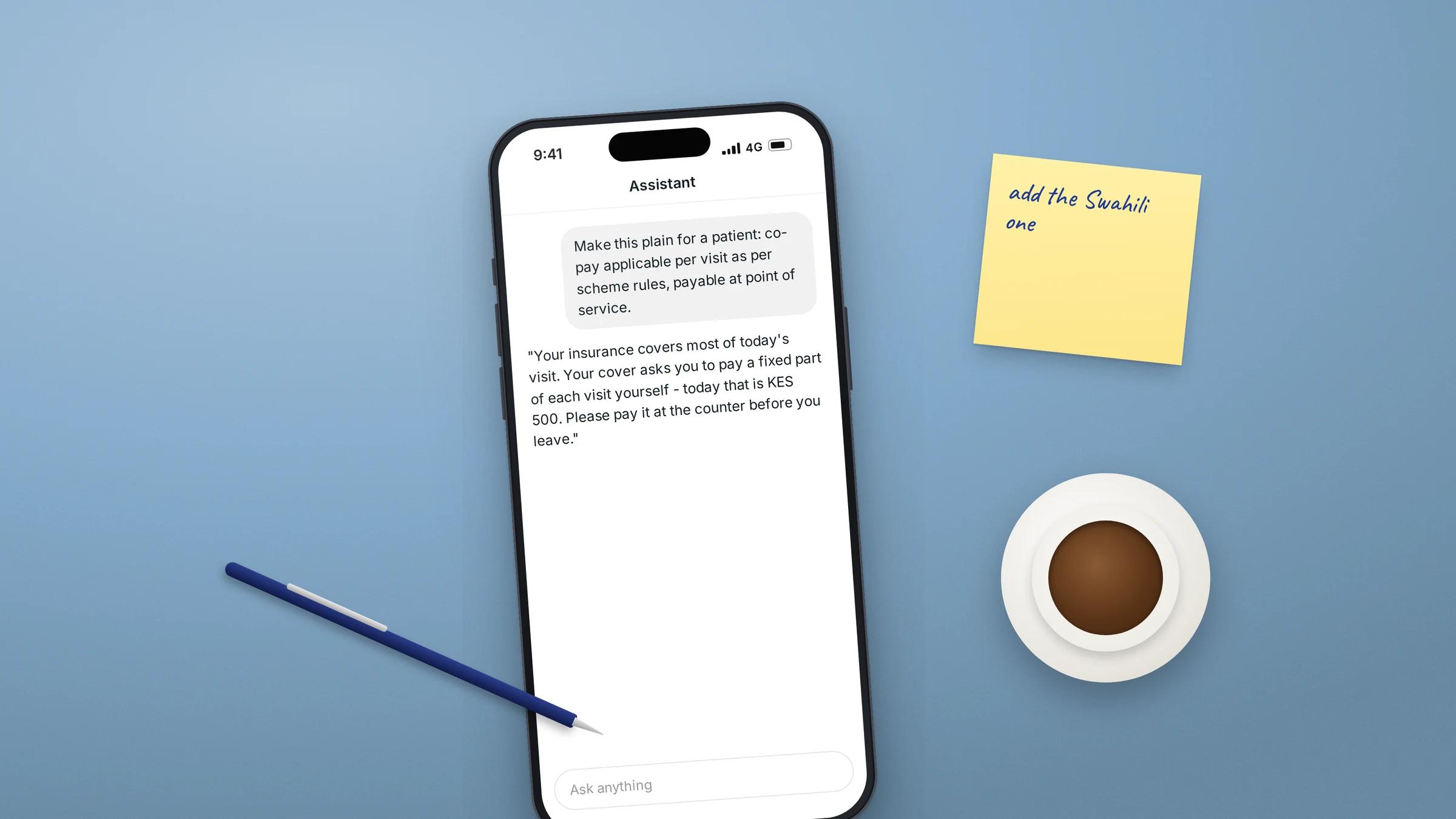
- Co-pay: a fixed part of each visit the patient pays even when insured.
- Exclusion: a service or medicine the patient's cover does not include.
- Limit reached: the cover's yearly or per-visit amount has been used up.
- Pre-authorisation: the insurer has to approve a procedure before it is covered, and the approval is pending or was declined.
- Cash price versus insurance price: why the same service is billed differently.
Each of these needs one clear explanation, written once, approved by the clinic manager, and used by everyone. When five cashiers explain co-pay five different ways, patients hear five different stories.
Let AI help with the wording#
This is where an AI assistant is useful, and it is Stage 1 on the NGAZI ladder: AI as a capable person you hand a writing task to. Give it the clinic's internal description and ask for a version a patient would understand:
Rewrite this for a patient with no insurance knowledge. Use short sentences and everyday words. Keep it under 60 words. Do not promise anything about what the insurer will pay. Then give me the same text in simple Swahili.
Then check every draft against your actual policy and your contracts with insurers. An assistant writes clearly; it does not know your schemes. If its draft says "your insurance will refund you", and that is not true, it must come out.
Put the explanation on the statement itself#
A good explanation said once at the window is forgotten by the time the patient gets home. A good statement keeps explaining. For each bill, show:
- What was done, in plain words, line by line, with the price.
- What the insurer is expected to pay, clearly labelled as expected if it is not yet confirmed.
- What the patient pays, and why, with the reason in words: "Co-pay for this visit", "Not included in your cover".
- How to pay: the paybill number and account reference, or the counter.
- Who to ask: a name or a phone number for billing questions.
The reason line is the one most statements leave out, and it is the one that prevents the argument. If your billing system has a notes field per line, the approved explanations can go straight into it.
Tell patients before the bill, not after#
The kindest explanation comes early. If the front desk knows at check-in that a patient's cover carries a co-pay, or that the service they are booked for usually needs pre-authorisation, a short message then avoids the surprise at the end: "Your cover includes a KES 500 co-pay per visit, paid at the counter." Our guide to insurance paperwork at the front desk covers the checks that make this possible.
Staff also need a simple rule for what happens when a patient disputes a charge: who they call, and that clinical questions go to clinical staff. Billing staff explain bills; they do not discuss diagnoses or treatment choices.
What to do this week#
List the five billing explanations your cashier gives most often. Write each one in your own words, ask an assistant to rewrite it in plain English and simple Swahili under 60 words, check every line against your actual policy, and have the manager approve the final versions. Print them for the cashier's window, and add the reason line to your bill template.