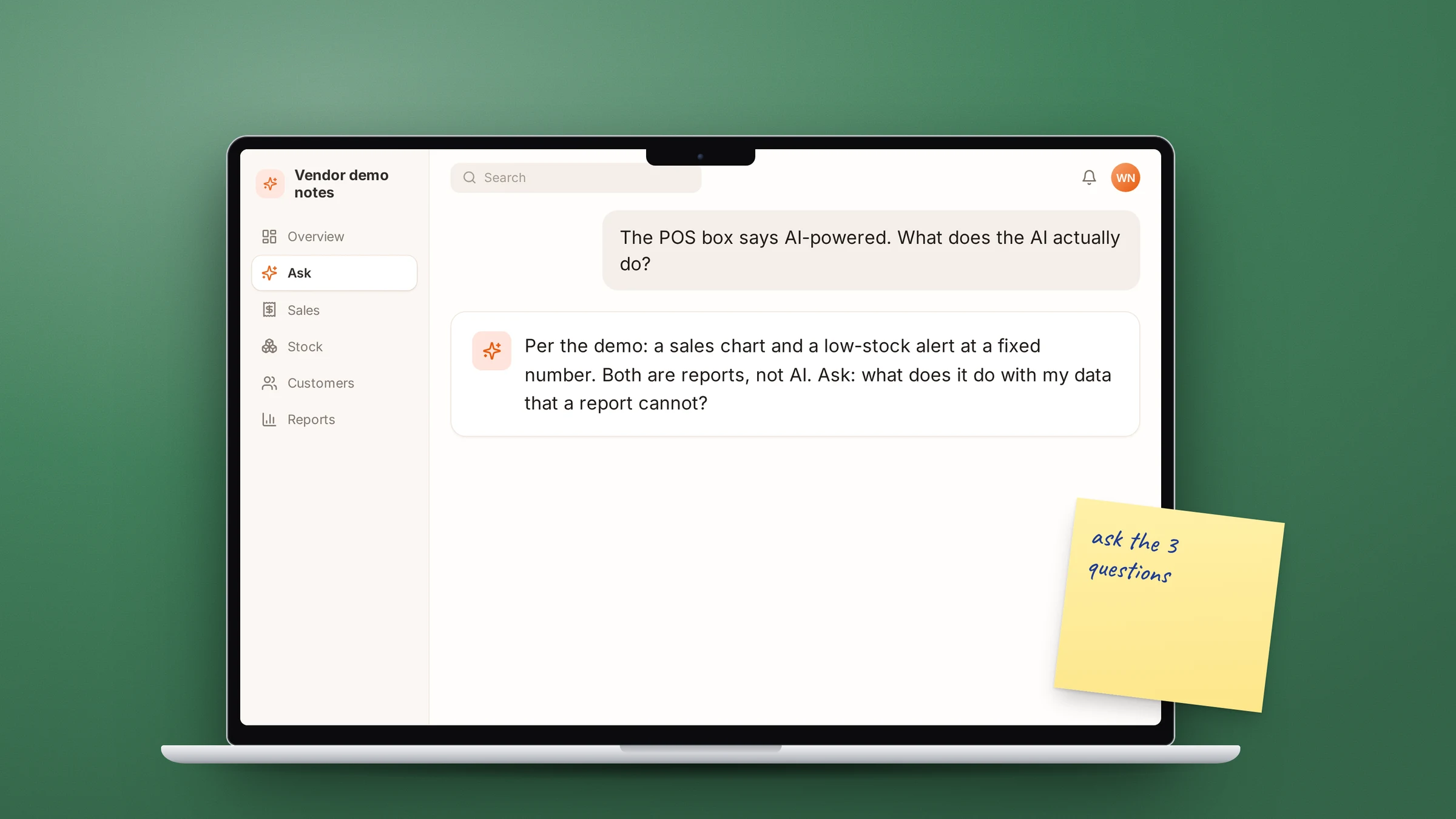
Picture a stand at a business trade fair, selling point-of-sale systems, with "AI-POWERED" in large letters across the banner, the brochure and the box. A shop owner asks the salesperson what the AI does. After a pause, the answer is: "It shows you your best-selling products." Then comes a bar chart.
A bar chart of best-sellers is useful. It is also something sales software has done for decades without anyone calling it artificial intelligence. The label was doing the selling.
This piece is not against AI products. We build them. It is about reading the label for what it is.
What the label tends to cover#
When you look behind the badge on business software and devices, you usually find one of four things:
A feature that was already there. Reports, charts, search, a stock alert when a number drops below 10. Useful, but these are rules and arithmetic. Renaming them does not change what they do.
A chat box on top. A general assistant added to the product, which can answer general questions but may not be able to see your records at all. Ask it about last month's sales and it may apologise, or worse, invent something.
Something genuinely new. Reading a supplier invoice from a photo, answering questions about your own records in plain language, drafting a reply from your own policies. These are things a plain report could not do, and they are worth paying attention to.
A plan for later. "AI features coming soon." Price it as what it is today.
None of these is a lie on its own. The problem is that the box looks the same for all four.
Question one: what can it do that a report cannot?#
Ask the salesperson for one specific task the AI does with your data that a normal report, filter or rule could not. Then ask them to do it, live, in front of you.
Good answers are concrete: "Ask it in Swahili which customers have not bought since June, and it answers from your records." "Photograph this delivery note and it drafts the stock entry for you to approve." Weak answers are general: "It learns your business." "It gives you insights."
If the demo uses a ready-made sample shop, ask whether you can try it with a small export of your own data before you buy.
Question two: show me it being wrong#
Every AI system is wrong sometimes. The question that matters is what happens when it is. Ask:
- Does it show where an answer came from, so I can check it?
- If it suggests changing something, such as an order or a price, does it wait for me to approve, or does it just do it?
- Can I undo what it did?
A vendor who has thought about this will answer immediately. One who has not will tell you it is very accurate. Accuracy is not the point; checkability is. We go deeper into this in no silent writes.
Question three: where does my data go?#
If the AI feature sends your sales, customer details or documents to an outside service, you need to know which one, where, and whether that data can be used to train models. Ask for it in writing. In Kenya, the Data Protection Act 2019 puts duties on you as the business holding customer data, so this is your question to ask, not only the vendor's to answer. Check official guidance or a professional for what applies to you.
What to do this week#
Look at the software and devices your business already pays for, and any you are being offered. For each "AI" label, write one line: what does it actually do? If you cannot say, ask the three questions at your next renewal or demo.
If you are weighing up a specific purchase, our list of six things to check before you pay for AI goes further. And sometimes the honest answer is that you do not need it yet; I wrote about talking a client out of buying AI for exactly that reason.